

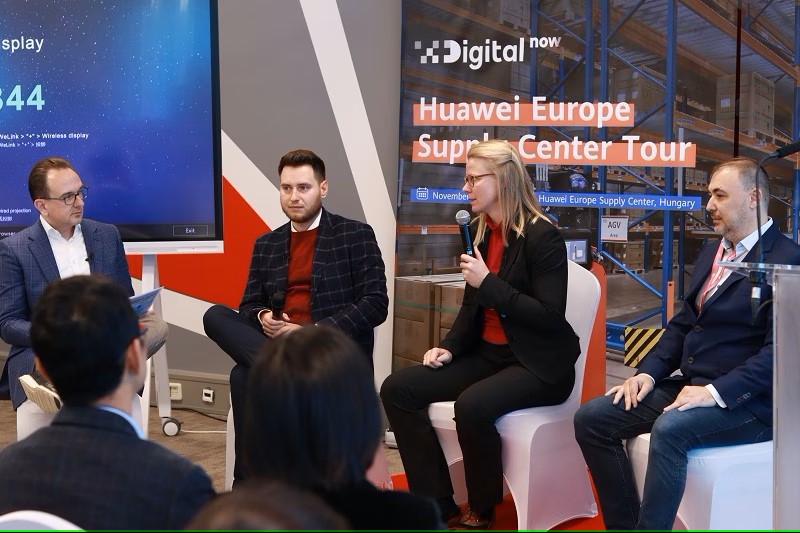
Huawei held the 5G Smart Factory Forum in Budapest, highlighting the potential applications of 5G-powered solutions like self-driving vehicles, AI-driven quality control, and AR-assisted remote maintenance in future smart factories.
Huawei plans to promote the inclusion of innovative 5G solutions for Industry 4.0 infrastructure in the Global Alliance on AI for Industry and Manufacturing (AIM Global), launched by the United Nations Industrial Development Organization (UNIDO), to drive widespread adoption of 5G and AI technologies in Industry 4.0 fields.
Huawei’s Vice Director of the Global Corporate Communications Department Vicky Zhang said that in its fourth year of commercial use, 5G, AI, and cloud computing technologies are used in various industries, especially in smart manufacturing. Mature best practices, like HESC in Páty, demonstrate these innovative applications’ tangible business and social value.
“Next, Huawei will work with international organizations like UNIDO to promote the sharing and application of 5G industrial infrastructure solutions and related capabilities around the world, in order to drive the development of Industry 4.0,” Zhang stated.
Huawei and UNIDO launched AIM Global in July to foster collaboration, knowledge-sharing, and AI technology innovation in the industrial and manufacturing sectors.
Germany’s University of Hohenheim Professor Dr Ulrike Fasbender identifies HESC as a prime example of the rapid development and innovation fueled by digitalisation.
“The impact of digital solutions such as augmented reality and autonomous forklifts enabled by 5G connectivity are a true game-changer for workplaces. If done right, these technologies let employees solve tasks more efficiently while shielding them from strenuous and unhealthy tasks. Such improved working conditions will be crucial for employability as the average age of the working population increases,” Dr Fasbender stated.
Dr Fasbender emphasised that countries and companies that neglect technology risk losing competitiveness in the digital economy and that an economy’s dynamicity relies on industry-serving ecosystems.
HESC Deputy Director commented, “HESC first deployed 5G-powered automation solutions at the end of 2019. Since then, we have integrated a dedicated core network with the local edge computing system to realize self-driving forklift trucks and the full automation of the entire logistics system. In addition, AI-driven quality control and AR-assisted remote maintenance have improved the logistics efficiency of our entire campus by 20%, greatly enhancing Huawei’s ability to serve its European customers.”
“Moving forward, Huawei will leverage its strengths in R&D, digital technologies, and supply chains to strengthen collaboration with all players across supply chains. We will also help empower local companies to enhance the adoption of digital and intelligent technologies during their production and operations, so that we can achieve high-quality development together,” he added.
HESC, based in Hungary, is Huawei’s largest supply centre outside China, supplying products to over 50 countries in Europe, Central Asia, and Northern Africa. It handles 50,000 to 60,000 items monthly and transports an average of 400 cubic meters of outbound cargo daily.