

Article By Paul Kyriakos, General Manager of SOLUM Oceania
Manufacturing has become increasingly digital, but the information workers rely on at the point of execution has not always kept up.
Production lines are automated, warehouses are connected and enterprise systems provide businesses with more data than ever before, while some of the instructions that guide day-to-day work still move through paper, printed labels and manual handoffs.
When information changes, paper needs to be replaced. When a work order is updated, someone needs to make sure the latest version reaches the right person. When a task is completed, the information may need to be manually recorded elsewhere.
Every one of these steps creates an opportunity for delay, omission or human error, and each delay can ripple through inventory accuracy, dispatch timing, production scheduling and customer service.
The hidden cost of paper-based operations
In Australia, the case for digitising shop-floor information is also a productivity issue. Australian Bureau of Statistics data shows that multifactor productivity across manufacturing fell 2.9% in 2024–25. This highlights the need for manufacturing businesses to look for ways to digitise and streamline processes.
This can be done by ensuring workers have accurate, up-to-date information at the point where they need it, rather than relying on instructions that can become stale as conditions change. Digital technology can connect business systems with the physical environments where manufacturing and logistics teams carry out their work.
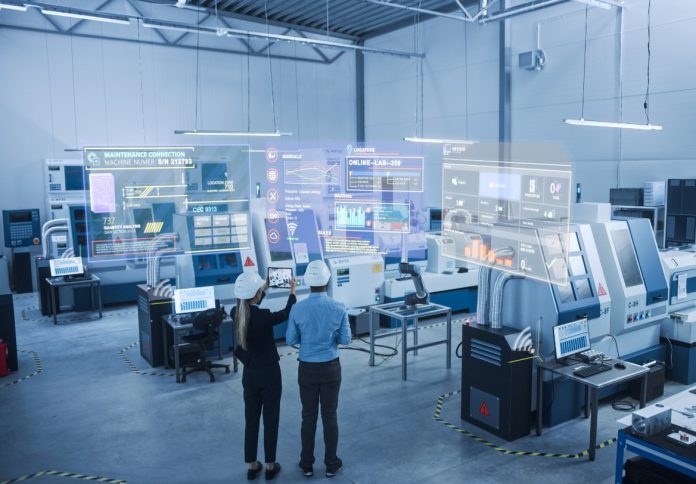
Digital displays can act as an operational interface between systems such as warehouse management platforms and enterprise resource planning software and the workers operating on the ground. Instead of relying on printed work orders, displays can show information such as SKU numbers, picking quantities and lot numbers in real time. When a task is completed, confirmation can also be sent back into the relevant system.
This brings instruction, execution, confirmation and system updates into the same digital workflow, helping streamline information updates and improve workflow consistency.
Making picking less dependent on memory
Workers in the manufacturing industry regularly need to locate and manage thousands of different components. Traditional picking can depend heavily on workers remembering locations and visually checking products against paper lists. This can increase fatigue and create opportunities for mistakes, particularly as the number and complexity of parts increase.
This process can be made more intuitive, with digital displays and ESLs. Flashing LED indicators will easily direct workers towards the relevant item. A confirmation mechanism can then feed completion information back into the relevant system, creating a more connected process from picking through to inventory updates.
The objective is to simplify routine workflows and improve operational consistency, making daily operations more efficient for workers.
The numbers make the case
The impact can be significant when digital tools are integrated into existing workflows. In one manufacturing operation, digitising the picking process reduced lead time from 40 minutes to 10 minutes, a 75% reduction. The improvement demonstrates how better access to real-time information can help workers complete routine tasks more efficiently and reduce unnecessary delays.
For manufacturers, improving the flow of information across existing operations can also reduce the friction created by manual processes.
The shift also aligns with Australia’s broader advanced manufacturing agenda. The Australian Government has identified advanced manufacturing as a key part of its $22.7 billion Future Made in Australia Plan, which aims to build a stronger, more diversified and resilient economy. As part of the plan, the government has established a $1.7 billion Future Made in Australia Innovation Fund to support innovation, commercialisation, pilot and demonstration projects and early-stage development in priority sectors.
For manufacturers, this broader policy focus reinforces the importance of investing in technologies and processes that can strengthen productivity, efficiency and capability.
Building a truly connected factory
When information can be updated as conditions change, workers can act on current instructions and managers can gain greater visibility into processes and task completion. Connecting shop-floor information with existing business systems can also help identify inefficiencies that are difficult to see when processes rely on manual updates.
The benefits can extend beyond reducing paper use. More responsive information flows can support productivity and accuracy while giving employees more time to focus on tasks that require their skills and judgement.
Manufacturers have invested heavily in connected machinery, automation and software to make production smarter. The next opportunity is to extend that connectivity to the information workers rely on every day. Even a highly automated production environment can still be slowed down by outdated work orders, paper instructions or manual handoffs.
As manufacturers look for ways to improve productivity and reduce errors, attention should extend beyond the major technologies on the production line to the everyday processes that enable people to do their jobs. A truly connected factory is one where information moves efficiently between systems, people and physical operations, giving workers the information they need when they need it.