


University of Waterloo engineers have developed a new imaging system equipped with artificial intelligence (AI) to advance cancer treatment monitoring.
According to the university, the new imaging system will enable high-intensity, concentrated ultrasound to eradicate a broad spectrum of cancerous, often fatal, tumours more safely and effectively.
“We are addressing a huge challenge for focused ultrasound treatment,” explained project leader Moslem Sadeghi Goughari, a research associate in the university’s Department of Mechanical and Mechatronics Engineering. “Our imaging system can tell doctors exactly how much of a cancerous tissue is destroyed. And it’s the first AI-powered ultrasound technique developed for focused ultrasound treatment.”
Focused ultrasound treatment, used since the 1970s to treat prostate, breast, and liver cancers without incisions, uses high-frequency sound waves to heat and kill cancer cells, effectively eliminating the need for surgery.
However, while targeted ultrasound treatment can be performed as day surgery and provides for a faster, more pain-free patient recovery, it has significant limitations that restrict its widespread use. Because it is difficult to manage precisely, the treatment may mistakenly damage healthy tissue around a tumour or leave part of a tumour untreated, allowing cancer to spread.
Sadeghi Goughari and his three engineering colleagues believe that accurate monitoring of this therapeutic treatment, while it occurs, is the key to resolving these issues. They began creating their own system because there was no effective solution available.
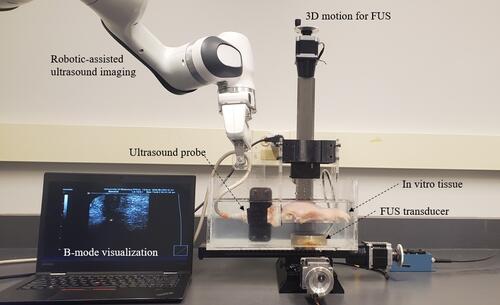
Researchers used a focused ultrasound transducer and ultrasound imaging probe to deliver ultrasound energy to a targeted area, capturing images. Aligning the probe and transducer was crucial for proper monitoring, and a robotic arm was used to ensure alignment. This allowed for precise images even as the transducer moved during treatment, ensuring accurate monitoring of the tiny area being ablated.
An AI framework has been developed for software integration with ultrasound procedures. It can quickly compare ultrasound images before and after treatment, handling 45 frames per second. This system can detect treatment area changes in less than 22 milliseconds, allowing real-time monitoring of focused ultrasound treatment.
The system, which has a 93% accuracy rate, can detect the extent of a tumour’s destruction, allowing doctors to accurately measure the ablated area margin within micrometres. This could aid in better controlling focused ultrasound treatment, ensuring tumour destruction without causing damage to healthy tissue.
The team plans to enhance their research by expanding their method and real-time monitoring of the growth of a treated area during treatment.