Seeing Machines has launched a Physical AI Platform designed to give humanoid robots and industrial automation systems greater awareness of people and their surroundings, with manufacturing among the industries identified as a potential application.
In a media release, the Canberra-based computer vision company said the platform extends its Human-Centred AI approach, developed through more than 25 years of research into human factors and artificial intelligence.
Seeing Machines said its driver and occupant monitoring technology is already deployed in more than eight million vehicles globally.
According to Seeing Machines, the new platform creates a dynamic three-dimensional perception map of people, objects and their surroundings. It is designed to help robots understand spatial relationships, interpret human behaviour, anticipate risks and make decisions in real time.
Seeing Machines CEO Paul McGlone said the technology represented an extension of the company’s work in human-machine interaction.
“For more than two decades, we’ve been teaching machines to understand people,” McGlone said. “With the launch of our Physical AI Platform we are extending that capability into robotics, enabling machines to interact with people safely, naturally and intuitively.”
Seeing Machines said the platform differs from AI systems focused primarily on identifying individual objects or performing predefined tasks by interpreting people, objects and the surrounding environment as a unified scene.
McGlone said this capability would become increasingly relevant as robots move into environments where they work alongside people.
“As robots begin moving beyond research labs and into factories, workplaces, hospitals, homes and public spaces, understanding people and the environment they’re in becomes just as important as understanding the task they’re performing,” he said.
Seeing Machines identified manufacturing, logistics, healthcare, aged care, warehousing, mining and industrial automation as potential application areas for the platform.
Article by Michael Murphy, director, operational technology (OT), Asia Pacific, Fortinet
Australia’s manufacturing sector is entering a new phase of digital transformation. Artificial intelligence (AI), automation, and connected operational technologies are reshaping production environments, helping manufacturers improve productivity, strengthen supply chain resilience, and remain globally competitive.
The recent “AI in Australia’s interests” announcement by the Australian Government reinforces the growing importance of AI as a driver of Australia’s future economic growth, with advanced manufacturing expected to play a significant role in that transformation.
As manufacturers embrace these technologies, cybersecurity has become an equally important consideration. In June, the Five Eyes cybersecurity agencies, including the Australian Signals Directorate (ASD), warned that AI is increasing both the speed and sophistication of cyber threats, urging organisations to treat cyber resilience as a strategic business priority rather than simply an IT responsibility.
For manufacturers, that advice couldn’t be more relevant.
Today’s production environments are more connected than ever before. Industrial control systems, sensors, robotics, cloud platforms, and remote maintenance technologies are creating unprecedented visibility and operational efficiency. However, every new connection also creates another potential entry point for cyber attackers.
Unlike many cyber incidents affecting traditional IT systems, attacks on operational technology (OT) can have immediate physical and operational consequences. Production lines can be interrupted, supply chains disrupted, and worker safety placed at risk. In an industry where uptime directly affects profitability and customer commitments, cybersecurity has become a fundamental component of operational resilience.
This growing convergence between IT and OT is changing how manufacturers approach cyber risk. Historically, factory systems operated separately from enterprise networks. Today, manufacturing organisations increasingly rely on integrated environments that let production data flow seamlessly across engineering, operations, and business systems. While this connectivity creates significant business value, it also requires organisations to rethink how they secure operational environments.
Encouragingly, manufacturers are making progress.
Fortinet’s latest State of Operational Technology and Cybersecurity Report found organisations continue to improve their OT cybersecurity maturity, with stronger executive engagement, greater collaboration between IT and OT teams, and improved visibility across industrial environments. These findings suggest manufacturers increasingly recognise that cybersecurity is a business resilience issue that supports safe and reliable operations, rather than just a technical issue.
However, the research also shows cyber incidents affecting OT environments remain common. As industrial environments become more connected and threat actors continue adapting their techniques, resilience depends on continually strengthening cybersecurity instead of viewing it as a one-time investment.
One of the most significant opportunities for manufacturers is improving visibility across operational environments.
Many Australian manufacturers operate facilities that have evolved over decades, combining modern digital technologies with legacy industrial equipment that continues to perform critical production functions. Without a comprehensive understanding of every connected asset, organisations cannot effectively assess vulnerabilities, detect abnormal behaviour, or respond quickly when incidents occur.
Visibility forms the foundation of effective cyber resilience. Knowing exactly what assets exist across operational environments means organisations can better understand operational dependencies, prioritise remediation efforts, and make informed decisions about where security investments will have the greatest impact.
At the same time, manufacturers must recognise that legacy equipment is often an operational necessity rather than a cybersecurity weakness that can simply be replaced. Industrial assets are designed for long service lives, and wholesale replacement is rarely practical. Instead, manufacturers should focus on reducing risk through network segmentation, continuous monitoring, secure remote access, and layered security controls that protect critical systems while letting production continue uninterrupted.
AI also presents opportunities beyond manufacturing productivity. It can strengthen cyber defence by helping organisations detect anomalies more quickly, analyse large volumes of operational data, and improve incident response. Used responsibly, AI has the potential to become an important tool for protecting increasingly complex industrial environments.
Ultimately, cybersecurity is becoming inseparable from manufacturing performance. Decisions about digital transformation, operational efficiency, and AI adoption increasingly influence cyber risk, making collaboration between engineering, operations, and cybersecurity teams essential.
Australia’s manufacturers have always embraced innovation to remain competitive. Today’s transformation is no different. The organisations that will be best positioned to succeed are those that build cybersecurity into every stage of their digital transformation as a core enabler of resilient, efficient, and sustainable operations.
As Australia’s manufacturing sector continues to modernise, resilience will depend not only on adopting new technologies and securing them well. Manufacturers that also strengthen visibility across operational environments, protect critical systems, and integrate cybersecurity into business decision-making will be better placed to maintain production, support their workforce, and capitalise on the opportunities created by the next generation of industrial innovation.
Researchers from IMDEA Materials Institute have developed an artificial intelligence algorithm designed to improve automated manufacturing by identifying the unique operational characteristics, or “personalities”, of individual machines, even when they are the same make and model.
The researchers said one of the key challenges in large-scale automated manufacturing is that identical machines do not always perform in exactly the same way.
These variations can accumulate over time, potentially resulting in manufacturing defects and reduced reproducibility, particularly in high-precision industries such as additive manufacturing for architecture and aerospace.
To address this, the AI algorithm first assesses each machine individually to create a performance profile using statistical analysis. It then determines whether the machines are similar enough to be optimised collectively for efficiency or whether each requires an individual optimisation strategy to improve accuracy.
To validate the approach, the research team tested the algorithm using three theoretically identical 3D printers. While the machines were expected to perform similarly, the system detected measurable differences between them and concluded that each printer required its own optimisation strategy.
According to the study, analyses of the printed components showed clear differences in performance between the machines, with the researchers finding that individual optimisation provided the most suitable approach for the case study.
The researchers said the findings demonstrated “significantly faster convergence and a substantial reduction in errors in the weight of printed parts compared with treating all machines equally and thus failing to correct appropriately for individual biases.”
They added: “Even mass-produced machines may have their own operational ‘personality’. Our system learns these differences and uses them to our advantage, determining whether it is more efficient to treat them as a team or as individuals.”
According to the researchers, the approach could improve manufacturing accuracy while reducing wasted resources.
“This not only improves accuracy, but also saves resources by avoiding failed experiments, a key step towards the fully automated laboratories and factories of the future,” they said.
Although the study focused on 3D printing, the researchers said the methodology could also be applied to other high-throughput experimental fields, including new materials discovery, chemical synthesis and sensor calibration.
The study was conducted by Dr. Christina Schenk, Miguel Hernández del Valle, Luis Calero and Dr. Maciej Haranczyk from IMDEA Materials Institute, together with Dr. Marcus Noack from Lawrence Berkeley National Laboratory.
The work received funding from the MAD2D-CM project, the Community of Madrid, Spain’s Recovery, Transformation and Resilience Plan, NextGenerationEU, the U.S. Department of Energy’s Office of Science through the CAMERA program, and the Spanish Ministry of Science and Innovation.
Manufacturers that modernise frontline workflows using technologies such as artificial intelligence (AI), automation, and data-driven tools are reporting productivity improvements and potential profitability gains, according to new research released by Zebra Technologies in collaboration with Oxford Economics.
The updated global study, which surveyed leaders across the manufacturing, retail, and transportation and logistics (T&L) sectors, found that 56 per cent of manufacturers reported productivity gains after modernising production lines.
The research also identified potential financial benefits, with manufacturers improving supply chain and inventory management reporting a potential profit increase of $6.6 million for a typical organisation, while modernised maintenance workflows were associated with a potential $6.2 million uplift and upgraded production lines with a potential $3.5 million increase.
According to Zebra Technologies, the findings suggest that improving frontline workflows with AI, automation, and real-time data can strengthen operational performance while supporting employee engagement.
The research also found that AI adoption is accelerating across industries. In manufacturing, half of the surveyed leaders seeking to improve production lines identified AI as their top priority for future progress.
“This updated research confirms that intelligent operations deliver a quantifiable human and financial impact, simplifying complexity, elevating frontline productivity, and improving engagement,” said Tom Bianculli, chief technology officer at Zebra Technologies.
“As a leader in AI for the frontline, we see how embedding intelligence directly into daily workflows turns insights into measurable action, unlocking the next wave of productivity and value for our customers.”
Beyond manufacturing, the study reported that retail organisations modernising point-of-sale operations could achieve a potential $4 million increase in profits, while transportation and logistics organisations improving shipping and loading workflows could see potential profit gains of $2.8 million.
It also found that 34 per cent of T&L firms that improved picking and packing operations reported better staff retention and satisfaction, while 54 per cent recorded faster operational speeds.
Zebra said the findings indicate that investments in technologies supporting frontline workflows can contribute to improved financial performance while enhancing employee satisfaction and customer experience.
The company added that its portfolio of products and solutions is designed to help organisations make real-time operational decisions, reduce manual errors, and streamline repetitive tasks.
According to Zebra, these capabilities enable frontline workers to improve productivity while supporting the broader adoption of AI-enabled workflows across manufacturing and other industries.
Oracle has announced new artificial intelligence-powered capabilities for its Oracle Fusion Cloud Supply Chain & Manufacturing (SCM) platform, including four new Fusion Agentic Applications designed to help organisations improve manufacturing efficiency, strengthen supply chain performance, and enhance inventory management.
The announcement said the new applications are built into Oracle Fusion Cloud SCM and are designed to help organisations improve inventory visibility, reduce supplier and operational impacts, and support faster decision-making across planning, procurement, and manufacturing. Oracle also introduced new inventory optimisation capabilities aimed at improving supply chain resilience.
According to Oracle, the new Fusion Agentic Applications are powered by teams of specialised AI agents that are designed to proactively identify issues, recommend actions, and automate routine work within established business controls.
“Supply chain leaders are under increasing pressure to improve service levels, control costs, and respond faster to disruption amid ongoing economic and operational uncertainty,” said S.Y. Shenoy, senior vice president of Fusion SCM development at Oracle.
“With the new agentic applications and inventory optimisation capabilities in Oracle Cloud SCM, organisations can identify issues sooner, prioritise actions, and make faster, more informed decisions across planning, procurement, and manufacturing,” Shenoy said.
Oracle said the four new applications include an Inventory Planning Command Centre to improve inventory availability and reduce stockouts, a Supplier Qualification Workspace to streamline supplier onboarding and compliance, a Production Readiness Workspace to help manufacturing teams reduce setup errors and prevent production delays, and a Kanban Administrative Workspace to support production flow through proactive replenishment management.
The company said the applications operate within the existing Oracle Fusion Applications security framework and are designed to automate routine processes while escalating exceptions or decisions requiring human judgement.
In addition to the new applications, Oracle introduced inventory optimisation capabilities within Oracle Fusion Cloud Supply Chain Planning.
These include multi-echelon inventory optimisation to recommend safety stock levels across supply chain networks, interactive inventory network visualisation to provide planners with greater visibility of inventory performance, and an Inventory Optimisation Advisor Agent that analyses service-level risks and recommends inventory adjustments.
Oracle said the updates form part of its broader Oracle Fusion Cloud Applications platform, which integrates supply chain planning and execution processes using embedded AI capabilities.
The platform also includes AI Agent Studio for Fusion Applications, enabling customers to build and deploy AI-powered automation using Oracle, partner, and external AI agents.
The company said the latest enhancements are intended to help organisations improve resilience and respond more effectively to changing market conditions through AI-assisted supply chain and manufacturing operations.
The future of environmental, social and governance (ESG) performance is being increasingly influenced by how organisations use technology in their day-to-day operations, according to thought leadership from Konica Minolta Australia.
John Harding, general manager, managed services at Konica Minolta Australia, said ESG outcomes are often shaped earlier in the operational process than many organisations realise.
“Organisations often treat ESG as something they report on after the fact; however, operations determine ESG performance. The way information moves, workflows are managed, and decisions are made all influence how efficiently and responsibly a business operates,” he said.
Harding said the concept of a “future office” is less about individual technologies and more about how systems and information platforms work together.
He noted that while many organisations are investing in digital tools, including cloud platforms, document management systems and automation, the value is maximised only when these tools are aligned with how a business actually operates.
“Paperless alone is not the end goal. The real value comes from improving how information flows through the organisation. When documents, data, and workflows are connected, businesses can operate with greater confidence,” he said.
He added that inefficiencies embedded in everyday processes can have a direct impact on sustainability outcomes.
“A lot of waste in business is hidden inside process, whether it be in form of duplicated effort, unnecessary manual handling, delays, or poor visibility. Technology helps organisations identify and remove friction,” Harding said.
Looking ahead, Harding said artificial intelligence (AI) will play a growing role in ESG, but should be applied in practical, operational contexts rather than as a conceptual solution.
“AI should not be treated as a shortcut to ESG maturity. Its value comes from applying it to real operational challenges,” he said, adding that stronger ESG performance will depend on how well organisations integrate technology, visibility and decision-making into their core operations.
A new manufacturing-focused partnership between the University of Canberra and OMRON Automation and Robotics Oceania aims to strengthen Australia’s capabilities in robotics, artificial intelligence (AI) and digital manufacturing, following the signing of a Memorandum of Understanding (MoU) to formalise collaboration on workforce development and industrial innovation.
The agreementbrings together the university and the industrial automation company to expand joint work in robotics, AI, digital twin technologies and advanced manufacturing, with both organisations framing the initiative as a step toward building a “future-ready” workforce for increasingly automated industries.
It also builds on an existing collaboration, with OMRON technologies already integrated into the University of Canberra’s Collaborative Robotics Lab.
University leaders said the partnership would help position Canberra as a growing centre for intelligent systems and advanced manufacturing research.
Vice-Chancellor and President Professor The Honourable Bill Shorten said the city’s ecosystem of research, government proximity and industry collaboration placed it in a strong position to lead in robotics innovation.
“With the powerful combination of research capability, government proximity and industry collaboration, Canberra is uniquely positioned to become the country’s heartland for robotics and systems innovation,” Shorten said.
He added that the collaboration with OMRON reflects a shared objective to prepare students for future industrial needs. “UC’s partnership with OMRON is built on a shared vision of developing a future-ready workforce, while advancing the technologies that will shape the future of manufacturing, logistics and automation,” he said.
OMRON Automation and Robotics Oceania managing director Henry Zhou said the agreement reflects the company’s long-term commitment to supporting Australia’s advanced manufacturing capability and skills pipeline.
“OMRON is proud to partner with the University of Canberra to help bridge industry and academia in areas that are critical to Australia’s future competitiveness,” Zhou said. “This collaboration brings together advanced robotics, AI, automation and digital twin technologies to help develop practical innovation pathways from research and prototyping through to industrial deployment.”
He added that workforce development is central to the partnership as manufacturing becomes increasingly digitised. “As advanced manufacturing rapidly evolves, partnerships like this are essential to building a future-ready workforce with the practical skills needed for increasingly digital and automated industries.”
The Embassy of Japan in Australia also welcomed the collaboration, with First Secretary and Science Attaché Shin Takakusagi highlighting the broader international dimension of the initiative.
“The partnership between the University of Canberra and OMRON represents an excellent example of how Japanese technology and Australian research institutions can work together to drive innovation and industrial transformation,” Takakusagi said.
“We look forward to seeing this partnership contribute to the future of advanced manufacturing, AI and robotics collaboration between Japan and Australia.”
Under the three-year MoU, both organisations will collaborate on robotics research, workforce training and applied innovation projects, with a focus on translating emerging technologies into manufacturing and logistics applications.
Professor Damith Herath, Founding Director of the Collaborative Robotics Lab, said the partnership is already generating industry-linked research opportunities.
“The initial focus will be on robotics, AI, automation for logistics and warehousing, and digital twin-enabled industrial systems, with the longer-term vision of establishing a jointly supported innovation hub within UC’s Collaborative Robotics Lab,” Herath said.
OMRON’s Head of Robotics, Luat Nguyen, said the collaboration will also provide students with direct exposure to industrial systems used in modern manufacturing environments.
“Through this partnership, students and researchers will gain hands-on access to industrial robotics, autonomous mobile robots, machine automation systems and digital twin environments that closely mirror modern manufacturing operations,” Nguyen said.
“By combining academic research with practical industrial technology, we can help accelerate innovation while building workforce capability for Australia’s rapidly evolving automation sector.”
According to OMRON, the partnership is also expected to influence curriculum development and expand student opportunities, including internships and work-integrated learning placements, as both organisations seek to align education more closely with the demands of advanced manufacturing industries.
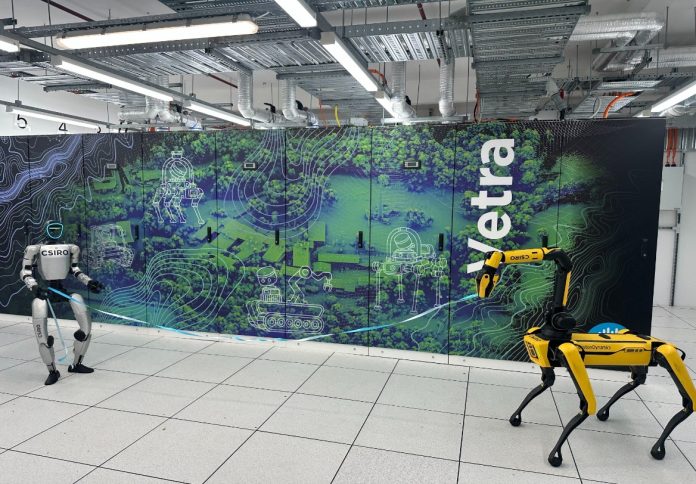
CSIRO's new AI infrastructure, Vetra, sits alongside Australia’s largest robotics research facility. Image credit: CSIRO
CSIRO has launched new artificial intelligence infrastructure designed to bring high-performance computing closer to where data is generated, supporting real-time learning for robots and other physical AI systems as demand grows for faster, on-site processing.
The system, named Vetra and based at CSIRO’s Queensland Centre for Advanced Technologies in Pullenvale, is intended to support “edge AI” applications by enabling processing directly alongside robots and sensors rather than relying solely on remote cloud systems.
CSIRO said the shift reflects growing use of AI in physical environments where speed and reliability are critical. “AI is rapidly moving beyond digital systems into the physical world, including robots, infrastructure, sensing and safety critical environments,” said Dr Liming Zhu, Director of CSIRO’s Data61.
He said Vetra is designed to provide “sovereign, trusted AI computing at the edge,” allowing systems to process and respond to data in real time.
“Vetra enables real-time physical AI research by bringing high performance computing to the edge, where proximity to data allows systems to respond, learn and operate safely in complex environments in ways that are not possible with cloud only or distant data centre approaches,” Dr Zhu said.
CSIRO said Vetra operates alongside its larger supercomputing systems in Canberra as part of an “edge-core-cloud” model, where immediate processing is handled locally before data is sent for deeper analysis. Dr Peyman Moghadam, Head of CSIRO’s Embodied AI Cluster, said this approach is essential for robotics development in real-world environments.
“Robots and physical AI systems need to keep learning from the physical world, not just from internet datasets or simulations,” Dr Moghadam said. “Vetra gives us the missing edge layer for this workflow, helping turn real-world robotics data into better, safer and more adaptable AI systems.”
The infrastructure has also been designed with energy efficiency in mind, using carbon dioxide-based cooling and closed-loop liquid cooling systems to reduce reliance on water-intensive methods.
CSIRO said this approach significantly reduces environmental impact, with the system expected to save about 225 tonnes of carbon dioxide emissions annually, equivalent to removing around 50 cars from Queensland roads each year.
CSIRO Chief Technology Officer Angus Macoustra said sustainability was a core design consideration. “High-performance AI systems generate a lot of heat in dense, enclosed spaces. Vetra shows how advanced technology can be delivered in a way that significantly reduces water use and emissions,” he said.
Vetra includes 48 high-performance graphics processing units and was developed with support from Australian small and medium-sized businesses, including Oper8 Global and XENON, alongside international technology partners.
Artificial intelligence could play a decisive role in lifting Australia’s future living standards, but only if the country takes a strategic approach to investment and control, according to the UNSW AI Institute.
Dr Sue Keay, Director of the UNSW AI Institute, said productivity growth remains closely linked to quality of life and that artificial intelligence may be a key driver in reversing stagnation in efficiency gains.
“Productivity can be directly linked to our standards of living. And so typically if you start to see productivity stagnating, then that can influence how much we can afford to buy from other countries and generally how comfortable we feel with the wage that we’re all receiving,” Dr Keay said.
She said there are limits to how much productivity can be improved through human effort alone, noting that most historical gains have come from technology rather than labour inputs.
“There’s a limit to how much you can improve a country’s productivity just through labour productivity alone, because I’m sure people probably don’t feel that they can work that much harder than they currently are,” she said.
“The main way that we’ve seen a lot of productivity improvements in the past has been related to technological advances.”
Speaking on UNSW’s Engineering the Future podcast,Dr Keay said artificial intelligence could help automate repetitive tasks, improve operational efficiency and support decision-making across both public and private sectors. She also said the technology may assist in addressing labour shortages by enabling organisations to operate with fewer constraints.
“The opportunity with artificial intelligence is that both at an individual level and at a company and governmental level, they can be applied across a whole range of functions,” she said.
“If you can start to scale a lot of those solutions and in particular areas where we find it difficult to find people to do work, then that’s obviously an advantage.”
However, she cautioned that Australia risks missing out on the economic benefits if it does not actively engage with the technology’s development and adoption.
“It really isn’t an option for us to just bury our heads in the sand and hope that this technological change won’t impact on us. We have to figure out how we can harness the benefits,” she said.
Dr Keay also raised concerns that artificial intelligence could function as an “extractive” industry if value creation remains concentrated offshore, with much of the technology developed and monetised by overseas companies.
“The people who are leading the development of these tools and making all of the profits from them are not Australian companies,” she said.
She noted that Australia currently relies heavily on imported AI technologies, particularly from the United States, and warned this could have longer-term economic implications if not addressed.
“We are purchasing most of our artificial intelligence, particularly from the US, and yet those companies we know tend to pay very little tax here in Australia,” she said.
“That will have devastating consequences unless we find ways to either develop alternatives, and really invest in Australian AI as a competitive advantage to make sure that we are generating Australian tax-paying companies to support our workforce.”
Dr Keay also highlighted data sovereignty as a key factor in ensuring Australia can fully benefit from artificial intelligence development, arguing that greater control over data could enable the creation of locally relevant AI systems.
“If we have more control of our data, then that lends itself for us to be able to build our own AI-specific models that are beneficial to us and not necessarily to anyone else,” she said.
She added that Australia should be cautious about allowing unrestricted data flows without safeguards, warning of potential consequences for national autonomy.
“We can’t be powerless or give up our agency to other countries unless we’re prepared to potentially lose our sovereignty.”
A shift is occurring in the global industrial sector as manufacturers move away from small-scale experimentation and focus on deploying capabilities across entire operations, according to Rockwell Automation’s 11th annual “State of Smart Manufacturing” report.
The global survey, which involved more than 1,500 manufacturers across 17 countries, found that manufacturers are no longer debating the merits of adopting digital technologies. Instead, executive focus has shifted to the execution, scaling, and delivery of measurable value from these investments.
This transition marks a significant inflection point for the sector, with fewer organisations operating in temporary pilot phases and a clear majority deploying smart capabilities directly into daily operations, Rockwell explained.
Today, nearly six in 10 manufacturers report that they actively use smart manufacturing technologies to support their day-to-day operations. Meanwhile, only 18% of surveyed organisations remain in the pilot testing phase.
Blake Moret, chairman and CEO of Rockwell Automation, noted that manufacturers are currently facing more complexity and pressure than at any point in the past decade.
“What stands out in this year’s research is not just the challenges, but how leaders are responding – by making digital transformation a core operating priority. The organisations that are seeing results are those that connect technology, people and processes to turn insight into better decisions, stronger performance and greater resilience.”
Currently, 34% of manufacturing operations are augmented by AI, which supports critical factory functions, including quality control, cybersecurity, and process optimisation.
Looking ahead, manufacturers project that more than half of all operations will be supported by AI capabilities by 2030.
At the same time, the study found that increased connectivity has brought heightened security challenges. According to the survey, 46% experienced at least one cyber incident within the past year.
This rising exposure, driven by increasingly connected and autonomous systems, means that secure, integrated IT/OT architectures have become foundational requirements for safely scaling AI and advanced automation.
To view the complete 2026 State of Smart Manufacturing report, visit rockwellautomation.com.
Article by Bob Buttermore, Senior Vice President and Chief Supply Chain Officer, Rockwell Automation
For decades, decisions about manufacturing location were heavily influenced by labour...
Article by Steven Fong, Corporate Vice President, APJ Embedded Business AMD
Artificial intelligence is entering a new phase—one that extends beyond digital productivity into the...
Manufacturing teams could use expanded artificial intelligence (AI) capabilities to automate repetitive tasks and connect product data across the lifecycle, according to Autodesk.
The company...
Engineers Australia has called on the Federal Government to place engineering and technical expertise at the centre of Australia’s approach to artificial intelligence (AI),...
Wurth Australia is investing in automated order fulfilment at its Yatala, Queensland and Keysborough, Victoria distribution facilities through a new partnership with supply chain...