
Japanese supercomputer simulations showed that wearing two masks gave little benefit in blocking viral spread compared with one properly fitted mask.
Researchers used the Fugaku supercomputer to model the flow of virus particles from people wearing different types and combinations of masks, according to a study released on Thursday by research giant Riken and Kobe University.
Using one surgical-type mask, made of non-woven material, had 85% effectiveness in blocking particles when worn tightly around the nose and face.
Adding a polyurethane mask on top boosted the effectiveness to just 89%.
Professional grade N95 masks were the best in protecting against infection, followed by non-woven masks, cloth masks, and finally polyurethane types, the study showed.
Japan’s supercomputer shows doubling masks offers little help avoiding viral spread
Qualcomm’s Snapdragon Sound Certification promises a huge wave of hi-fi wireless headphones

Qualcomm announces Snapdragon Sound. The company’s describes it as “a chain of audio innovations and software” that work together to significantly improve audio quality when listening to music through wireless headphones, earbuds, and other devices.
The goal is to deliver “high-resolution, wired quality audio, wirelessly,” according to James Chapman, Qualcomm’s VP of voice, music, and wearables.
One thing that Snapdragon Sound doesn’t particularly focus on is multipoint pairing for two simultaneous Bluetooth connections.
Good quality audio is always heavily dependent on the source, so you’ll need one of those services to get the most from Snapdragon Sound when it begins reaching products.
World’s First Space Hotel to Start Construction in 2025
The world’s first space hotel will begin construction in 2025. It will feature restaurants, a cinema, spa and rooms for 400 guests.
Orbital Assembly, a large construction company, announced in a virtual event on its Youtube channel that it was on track to start construction.The work is due to start in low Earth orbit in 2025.
Tourists are required to undergo some training (both safety and physical) before boarding their SpaceX Starship shuttle to Voyager Station, which is designed to accommodate 280 eight guests and 112 crew members. That will include people there for space tourism alone, scientists conducting low-gravity research and service industry professionals doing what they do best — but in space.
“It’s going to happen fast when it starts,” said Orbital Assembly’s chief executive John Blincow. “And we believe it’s going to happen a lot, too, even before we finish the first one. We have buyers for other stations because they’re very, very lucrative.”
The “deal with it” glasses were sold as NFT for $22,000

Another iconic meme went up for auction as an NFT. The test and sunglasses used to popularize “deal with it” GIFs.The meme was listed by creative director and “art prankster” Ryder Ripps. Who made headlines for falsely claiming to be behind the dystopian redesign of the CIA’s website.
Ripp appears to be closely related to the “deal with it” meme at least, even if the decade-old image’s exact origin is difficult to verify entirely.
The text and glasses were popularized in 2010 on the image sharing site Dump.fm, which Ripps co-founded.
NFT sales have been blowing up over the past couple of weeks. Nyan cat sold for $592,000 in cryptocurrency at the time of sale.And digital artist Beeple is currently auctioning an NFT at Christie’s, with bidding now at $3.5 million with a week remaining.
WhatsApp’s desktop app now has voice and video calls

WhatsApp’s desktop app for PC and Mac is getting voice and video calling, the company announced. The feature offers end-to-end encrypted calls to other WhatsApp users on both mobile and computer devices.
WhatsApp started to roll out the desktop calling feature for a small group of users at the end of last year. But today’s launch means that the feature is now available to all WhatsApp users on desktop. This makes calls a more ubiquitous feature across all WhatsApp devices.
And similar to the existing video call feature, the new desktop calling promises the same end-to-end encryption-which means Facebook and WhatsApp can’t hear or see your calls.
To use the new video calling feature, you’ll have to set up the WhatsApp desktop app on either Mac or PC, which requires that you already be a WhatsApp user on mobile. Once you’ve installed the app on your computer, users will then scan a QR code to log in on the desktop app, after which they’ll be able to use the desktop version of WhatsApp with their usual account.
OpenHaystack is the new open-source tool that lets you create DIY AirTags on Apple’s Find My network
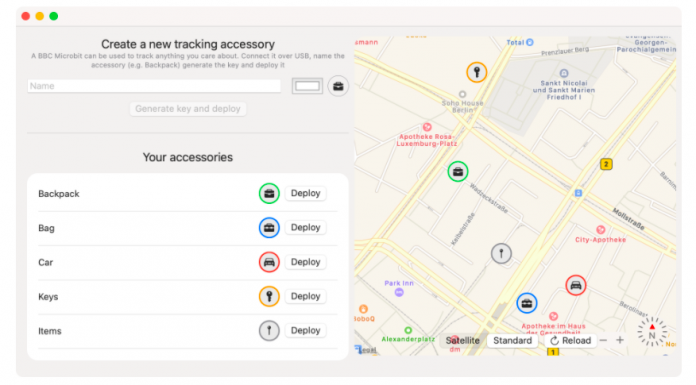
OpenHaystack is a new open-source tool that will let anybody make their own Bluettoth tracking tag to use with the Find My Network so they can track its location.The whole system is developed by security researchers at the Secure Mobile Networking Lab.
OpenHaystack works via a custom Mac app that can be used to track the location of custom tags that you create. As of right now, the tool has direct support to make a tracking tag using the BBC micro:bit mini computer, though other Bluetooth Low Energy (BLE) device support could be added by other developers in the future. Once registered on Apple’s Find My network, the OpenHaystack app will be able to report the tag’s location just like Apple’s Find My app works for iPhones and other Apple devices.
Though there aren’t any serious security implications for the Find My network itself, there is an important disclaimer on the project:
OpenHaystack is experimental software. The code is untested and incomplete. For example, OpenHaystack tags using our firmware broadcast a fixed public key and, therefore, are trackable by other devices in proximity (this might change in a future release). OpenHaystack is not affiliated with or endorsed by Apple Inc.
Hey now allows users create newsletters and blogs right from their emails
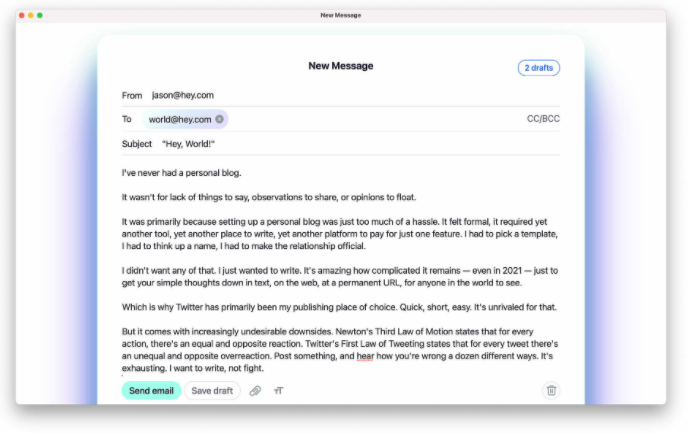
Hey, an alternative email provider, is expanding its offering with a new email newsletter and blog service called Hey World. The service is being offered as a free addition to all personal Hey subscribers, Hey announced on Thursday.
To use the service is very simple: Hey users simply need to send an email to world@hey.com. The subject of that email then becomes the post’s headline, while the body text is the blog post itself.Once you’ve sent the first email, Hey will automatically create a blog for you, at “world.hey.com/yourusername,” which collects all of your posts and offers both an RSS feed and an email subscription box for followers to keep up with your latest missives.
Hey co-founder Jason Fried explains that the feature was borne out of a desire for a place to share thoughts online in a longer-form context than a short Twitter post or tweetstorm, without the contentious public square of a place like Twitter.
Hey World blogs are available now for paying Hey subscribers with personal accounts; users on business accounts or with free trials aren’t eligible for the new feature.
SpaceX Starship rocket lands successfully ..then it blows up
Elon Musk’s Starship rocket made its landing ..until it blew up.
The latest heavy-duty launch vehicle prototype from SpaceX soared successfully into the sky in a high-altitude test blast-off on Wednesday from Boca Chica, Texas. Then it flew back to Earth to achieve the first upright landing for a Starship model.
However, the triumph was brief because slightly to one side of its fire-suppression system trained a stream of water on flames still burning at the base of the vehicle. This resulted in the spacecraft blowing into pieces about eight minutes after landing.
It was the third such landing attempt to end in a fireball after an otherwise successful test flight for the Starship, being developed by SpaceX to carry humans and 100 tons of cargo on future missions to the moon and Mars.
A first orbital Starship flight is planned for the year’s end. Musk has said he intends to fly Japanese billionaire Yusaku Maezawa around the moon with the Starship in 2023.
These gloves give people with tremor a helping hand

GyroGear, a UK startup, has developed gloves with built-in gyroscopes are help people with “essential tremor” regain control of their hands.
Parkinson’s disease and Essential tremor (ET) affect over 200 million people worldwide.
These conditions can cause patients’ hands to shake so much that everyday tasks such as eating and drinking become difficult or impossible.
GyroGear’s solution, according to Gordon McCabe, GyroGear development manager, is to mount a gyroscope on the back of the hand which, much like a spinning top that will always stay upright as long as it’s spinning, makes your hand stay level while the flywheel is spinning.
Two Extremely Rare Lightning Phenomena Caught in One Incredible Image

The National Science Foundation’s National Optical-Infrared Astronomy Research Laboratory (NOIRLab) released an incredible image – not of the cosmos, but of clouds around one of its observatories. The photograph shows not one but two rare lightning phenomena: blue jets and red sprites.
The red sprites are massive electrical discharges above thunderstorm clouds. Researchers believe that a particular combination of events has to occur for the formation of these phenomena. First of all, you have to have a thunderstorm – but that alone is not enough. Scientists believe that plasma irregularities in the ionosphere are also needed.
Blue jets are closer in behavior to the regular lightning, but instead of going down into the ground, they go from the upper level of the clouds further up into the atmosphere. Their color is believed to be related to the ionization of nitrogen in the atmosphere which results in ultraviolet emission. They are also briefer than regular lightning, lasting only for a few milliseconds.
As these phenomena happen above clouds, there’s no better viewpoint than the International Space Station. The Atmosphere-Space Interactions Monitor (ASIM), a European instrument dedicated to studying storms, has documented several of these rare events.Clearly, given the rarity of these phenomena, the photograph captured is a true gem.
Latest News

The new economics of localised manufacturing

AI Is Moving From “Know” To “Do”
Autodesk expands AI capabilities across manufacturing workflows

Engineers Australia calls for engineering expertise in Australia’s AI strategy