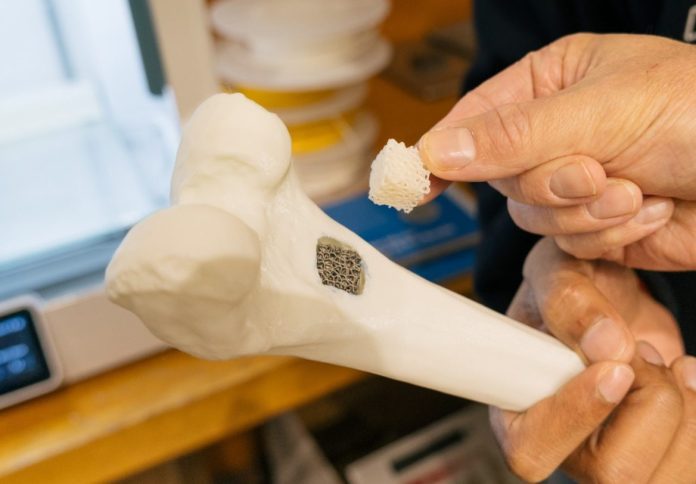
A 3D-printed implant using polylactic acid, a biodegradable polymer, with irregular and randomly designed patterns to better replicate the internal structure of bone to give cells a place to attach and regrow to rebuild tissue. Image credit: unsw.edu.au
UNSW Canberra researchers have developed a new 3D-printed bone implant that could transform the manufacturing of personalised medical devices and improve treatment for fractures and bone injuries.
According to UNSW,the implants, known as bone scaffolds, are porous structures that support bone regrowth.
Made from biodegradable polylactic acid (PLA), they provide a temporary framework for cells to attach and regenerate tissue, dissolving safely once healing is complete. This eliminates the need for additional surgeries to remove implants, the researchers noted.
“Bone can be damaged in many locations, and its structure changes depending on where it is in the body,” said PhD student Kaushik Raj Pyla, who led the research at UNSW Canberra.
“We wanted to see if matching these patterns could help restoration. Our idea was to take existing bone patterns and check if they could be rebuilt through printing.”
UNSW researchers used irregular, stochastic lattice designs to more closely replicate natural bone structure.
Laboratory tests showed the scaffolds performed well under sudden impacts, absorbing energy efficiently, while maintaining fluid permeability critical for tissue regeneration.
The university noted that innovative bone repair solutions are urgently needed, particularly in the ACT, where poor bone health affects more than 98,000 people.
“These figures highlight the growing burden of osteoporosis and fracture-related injuries – and the importance of developing safer, more effective treatments like the 3D-printed bone scaffolds,” Kaushik said.
UNSW researchers cautioned that the technology is not yet ready for clinical use. Future steps include biological testing, long-term studies, and regulatory approval.
The team said it is also exploring applications for cartilage and soft tissue scaffolds, with early clinical testing possible within five years.
“Biodegradable scaffolds will likely play a key role in reducing both medical risks and overall treatment costs,” Kaushik said. “We’re moving toward safer, more personalised implants that work with the body, not just in it.”
ACCIONA says a new collaboration with Australian surf fin maker Bolero Surf is highlighting how recycled renewable energy materials can support local manufacturing, with the launch of what the company describes as the world’s first commercially available surfboard fins made from recycled wind turbine blades.
The fins, unveiledat the 2026 Aussie Boardriders Battle (ABB), were designed and manufactured in Australia as part of ACCIONA’s Turbine Made initiative, which was launched in February 2025 to explore how materials from decommissioned wind turbine blades can be repurposed into new products.
Professional surfer Darcy Crump from Bungan Boardriders is set to debut the fins in competition during the event on the Gold Coast.
According to ACCIONA, the project aims to demonstrate how circular economy approaches can create new manufacturing opportunities by recovering valuable materials from renewable energy infrastructure.
Bolero Surf founder Banjo Hunt said the concept emerged after observing that many surfboards continue to use fins produced through manufacturing processes that are not environmentally sustainable.
“The fibreglass inside a wind turbine blade has so much inherent value, which for us means it can be turned into high-quality surfboard fins,” Hunt said.
“By reusing this material, we avoid one of the most expensive and labour-intensive parts of traditional fin manufacturing. That advantage is helping us bring production back to Australia. Crucially, the material is super strong and stiff, which perfectly lends itself to high-performance surfboard fins.”
The fins are designed to meet the performance requirements of modern surfing while demonstrating the potential for recycled wind turbine materials to be used in commercial-scale manufacturing.
Professional surfer Darcy Crump said performance remained the key factor when testing the product.
“As a surfer, performance comes first,” Crump said. “The fins feel solid, and quick around turns, and knowing they’re made from recycled turbine blades makes it even better.”
ACCIONA said the product launch builds on earlier awareness generated by its Turbine Made surfboard prototype, which used material from a retired turbine blade.
Gavin Reymond, Managing Director at ACCIONA Energía in Australia, said the fins represent the next step in demonstrating how recycled renewable energy materials can be integrated into new products and supply chains.
“Last year, we proved the Turbine Made concept by making the world’s first surfboards from a retired wind turbine blade,” Reymond said.
“This year, we’re showing how we can scale the initiative by creating a retail product, helping surfers not just surf better, but also more sustainably.”
Reymond said the collaboration also illustrates how circular economy thinking can support new forms of manufacturing activity in Australia.
“By bringing a Turbine Made product to market, ACCIONA and Bolero Surf are demonstrating that the renewables circular economy is not a future ambition, but something already happening in Australia today,” he said.
“This is a live case study for Australian designers, innovators, manufacturers and entrepreneurs of what is possible when we rethink end-of-life materials as the start of the next product.”
The Turbine Made surfboard fins are available to Australian and international consumers through Bolero Surf.
The global packaging industry is seeing a shift toward 2D barcodes, which can carry significantly more data than traditional linear barcodes, and an industrial printing technology provider is calling it a “strategic evolution” rather than a simple technical update.
In a recent industry briefing, German printing company Leibinger said manufacturers that act early to integrate these data-rich codes are positioning themselves for higher efficiency, improved regulatory compliance and a clear competitive advantage over slower-moving competitors.
However, the company also acknowledged that while the move to 2D codes represents one of the most ambitious transformations in modern packaging, the journey comes with several technical, organisational, and external challenges that require careful navigation.
According to Leibinger, the technical aspects of 2D code implementation present risks for manufacturers.
“2D codes are dense, data-rich, and highly detailed — which means printing precision is critical. Small deviations in droplet size, ink adhesion, or substrate reflectivity can cause scanner errors. Materials such as glossy film or transparent plastic require excellent contrast and stability to maintain readability,” the company explained.
The variable data component adds another layer of complexity. As batch numbers or expiry details change, so does the code pattern, requiring consistent calibration to prevent print quality deterioration.
Beyond the technical aspects, the German company also points out that many projects struggle because of unclear data ownership and management structures.
“If systems like ERP (enterprise resource planning), MES (manufacturing execution system), and printers aren’t fully synchronised, the digital workflow breaks down. The result: wrong data on the right code — or the right data printed too late.”
Leibinger added that even if manufacturers achieve internal readiness, the broader retail environment faces its own challenges.
“Not all retailers’ POS scanners are 2D-ready yet, so during the transition phase, dual coding — printing both a 1D barcode and a 2D symbol — will remain necessary in many cases,” the company said.
The company notes that user acceptance presents another challenge, as operators, retailers, and consumers adapt to new ways of interacting with packaging.
Manufacturing research at IMDEA Materials Institute has demonstrated a new way to increase the flexibility of 3D-printed nickel–titanium alloys, using woven architectures to overcome limitations associated with additive manufacturing.
In a studyconducted with the Technical University of Madrid (UPM) and published in Virtual and Physical Prototyping, researchers reported that highly deformable, interwoven nitinol structures can achieve mechanical performance not previously possible with conventional 3D-printed approaches.
IMDEA Materials Institute said nickel–titanium alloys, commonly known as nitinol, are widely used for their superelastic and shape-memory characteristics, especially in biomedical devices and other high-performance engineering applications.
The institute noted, however, that when nitinol is manufactured using laser powder bed fusion (LPBF) – the most commonly applied additive manufacturing method for the alloy – the resulting components generally exhibit reduced elasticity compared with those produced through established industrial manufacturing processes.
“While LPBF remains the gold standard of nitinol additive manufacturing, the shape-memory and superelastic properties of these additively manufactured NiTi parts do not yet match those achieved with more conventional industrial processes,” said Carlos Aguilar Vega, a researcher at IMDEA Materials and UPM, and a co-author of the study.
Rather than focusing solely on material optimisation, the research team adopted a design-centred manufacturing approach, using geometry to enhance mechanical performance.
The work focused on complex woven forms, including meshes, rings and tubular structures, produced directly through additive manufacturing.
“These were some of the most complex-shaped woven nitinol structures ever created,” said Prof. Andrés Díaz Lantada of UPM and IMDEA Materials Institute. “They demonstrate the possibility of achieving self-supported NiTi wovens via LPBF techniques.”
According to the researchers, mechanical testing showed that properties such as stiffness, load-bearing capacity and energy absorption could be adjusted across several orders of magnitude through design alone.
Computed tomography was used to compare printed components with their digital models, confirming the accuracy and robustness of the manufacturing process.
“This work represents the first demonstration of design-based optimisation of additively manufactured superelastic nitinol,” Aguilar Vega said, adding that architectural design can help mitigate mechanical drawbacks inherent in current additive manufacturing methods.
The research was carried out by a joint IMDEA Materials and UPM team and supported by the Comunidad Autónoma de Madrid through the iMPLANTS-CM research and innovation programme.
Australian print businesses are rethinking manufacturing strategies in 2026, with automation and digital inkjet technologies reshaping how production moves through the factory floor, according to Jet Technologies.
In a statement, the company said ongoing labour shortages, rising turnaround expectations and increasing job complexity are prompting printers to reduce manual intervention and streamline manufacturing workflows.
Jack Malki, Director at Jet Technologies, said the most significant change underway is a structural shift toward production environments with fewer touchpoints and greater reliance on digital platforms.
“Printers are being asked to deliver more jobs, in more variations, with fewer people involved at every step,” Malki said. “That combination simply isn’t sustainable with traditional, labour-intensive workflows, and it’s why we’re seeing sustained momentum behind digital print — particularly inkjet.”
According to Jet Technologies, digital inkjet is increasingly being assessed not only on print quality or run length, but on its ability to simplify manufacturing processes and reduce manual handling across the business.
“In many cases, the difference in touchpoints compared to conventional print is substantial,” Malki said. “Digital print allows work to move through the business with far less manual handling.”
The company noted that presses alone are not driving change. Printers are also investing in automation beyond print engines, including Management Information Systems, automated artwork intake, pre-press preparation, variable data workflows and finishing systems.
“Automation is often underestimated,” Malki said. “The biggest gains happen when everything is connected. Even simple job-memory functions can save an enormous amount of time when complexity increases.”
Labour availability remains a consistent pressure point across labels, packaging and commercial print, Jet Technologies said, citing an ageing workforce and ongoing challenges in attracting and training younger staff.
“There isn’t a single business we work with that isn’t feeling labour pressure in some form,” Malki said. “It’s universal, and it’s the main driver behind the structural changes we’re seeing.”
As a result, the company said digital platforms and automation are increasingly viewed as essential to maintaining output, consistency and quality with fewer skilled operators.
Jet Technologies also reported growing interest in digital embellishment, particularly in labels. One emerging area highlighted by the company is label contouring, where inkjet embellishment creates multi-height, tactile finishes.
“Once brand owners see contoured, tactile labels, flat print starts to feel very ordinary,” Malki said. “It adds a level of engagement that’s difficult to achieve any other way, and the response from brands has been extremely strong.”
On sustainability, Jet Technologies said adoption remains uneven across the industry, varying between segments and even among customers in the same category.
“There’s a very broad spectrum, from minimal change through to genuinely embedded sustainability strategies,” Malki said. “In the past, there was a lot of re-labelling of existing products, but that’s starting to give way to more meaningful change.”
He added that recent progress has been supported by new materials offering improved environmental outcomes without compromising performance or cost.
“When a sustainable solution is accessible and commercially realistic, the industry does move,” Malki said, citing laminating films containing recycled content as an example of products that have moved from niche to mainstream.
Looking ahead, Jet Technologies said print businesses that continue investing in digital inkjet, automation and connected manufacturing workflows are likely to be better positioned to manage labour constraints while meeting increasing demands for speed, variation and complexity.
Precision Plastics Australia has unveiled DesignLab.au, a new platform designed to link global product designers with Australian additive manufacturing capability, in a move that reflects the growing shift toward locally produced, design-led consumer goods.
The Sydney-based company, which has spent the past five years expanding its industrial 3D printing operations, says the initiative demonstrates how manufacturing in Australia can remain competitive by focusing on speed, flexibility, creativity and just-in-time production.
In an exclusive interview with Australian Manufacturing, Dr Craig Morrison, founder of Precision Plastics and DesignLab.au, said the platform formalises a model the company has been refining since 2020, when supply chain disruptions and rising freight costs exposed vulnerabilities in traditional offshore manufacturing.
“DesignLab.au was built on a simple idea — that world-class design doesn’t have to be manufactured overseas,” Morrison said.
“By combining global creative talent with our advanced local production and retailer network, we’re proving that innovation, sustainability, and style can thrive together — right here at home in Australia.”
Design–manufacturer collaboration and workflow
According to Precision Plastics, the platform provides end-to-end support from digital design submission to local just-in-time manufacturing.
Morrison said the combination of high-volume additive manufacturing, digital collaboration systems and domestic distribution enables designers to bring products to market without sacrificing creative fidelity or production efficiency.
“We employ a number of prototyping processes, including close designer–manufacturer collaboration on materials, colours and textures, along with local production oversight to assure consistent quality,” he said.
“For efficiency, we scale by using just-in-time workflows across our large-scale print farm, employ batch process automation methods, a proven raw material base, and local vertically integrated supply chains to produce wonderful products from world-wide designers delivered on-demand to local retailers for sale to Australian consumers,” Morrison explained.
Production capacity and advanced additive technologies
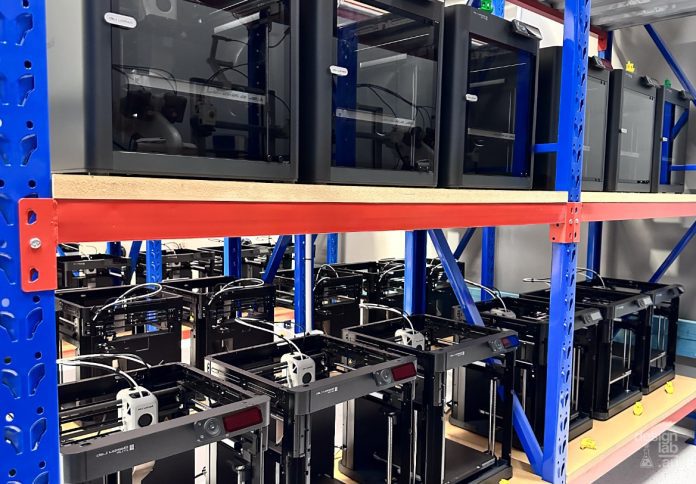
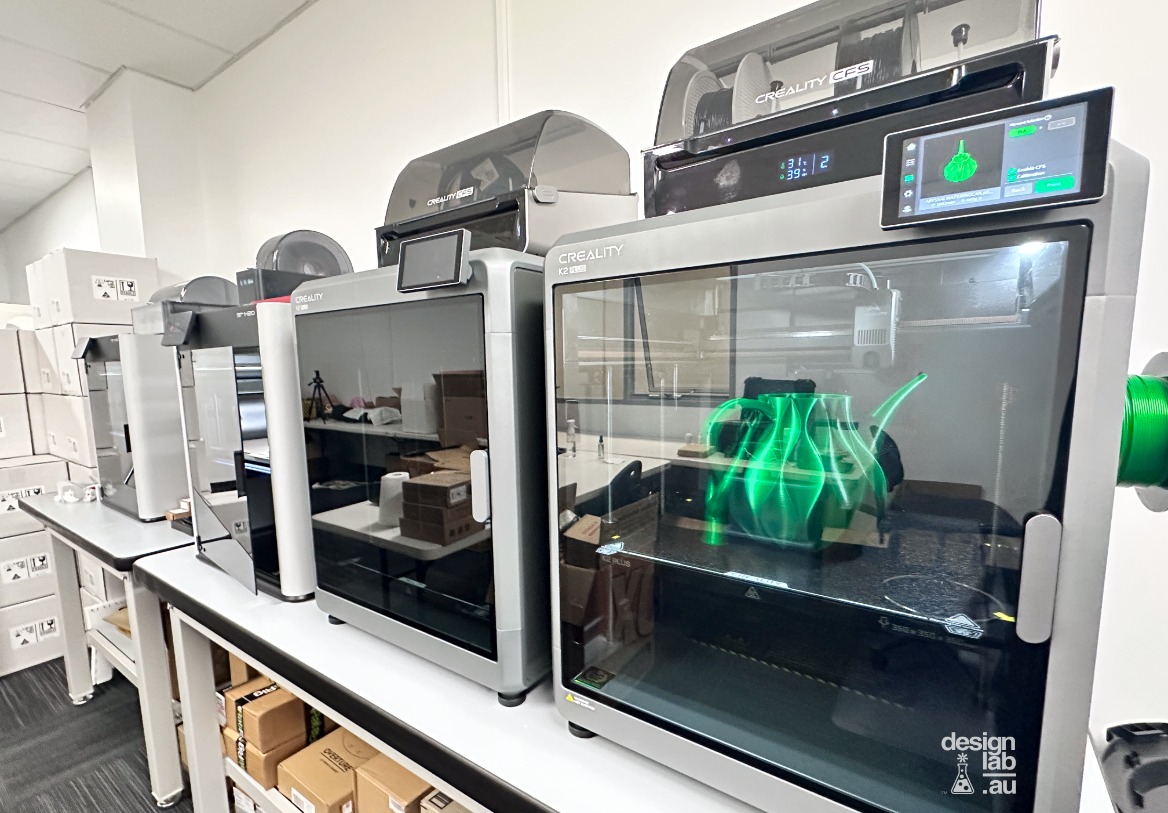
The company said DesignLab.au is underpinned by Precision Plastics’ production capacity, which includes more than 100 FDM and SLA printers from Bambu Lab, Raise3D, Prusa and Formlabs, operating in its Lane Cove facility.
Image supplied by DesignLab.au.
It noted the printers support materials ranging from PLA and ABS to nylon and carbon-fibre composites, alongside laser CNC capabilities for hybrid production. Morrison noted that this scale allows the business to operate with the flexibility required for just-in-time manufacturing.
“Capacity and flexibility matter,” he said. “We can respond to demand fluctuations quickly. With a large fleet of printers, we can absorb designer and retailer needs and ramp up or down.”
Sustainability and material innovation through scale
Morrison said that scale is also playing a critical role in sustainability and material innovation. The company argues that localisation reduces transportation emissions, while on-demand production helps minimise waste created by excess inventory.
“Our large print farm means we can scale variations without massively increased cost/lead time,” he said.
He added that volume gives the company more scope to experiment with new materials, including recycled and recyclable plastics, composites and specialised finishes for home-décor applications.
“Without scale, the ability to offer many materials may well be uneconomic,” Morrison said. “Scale enables material innovation, more exotic finishes, custom colours and textures — all consistent with our DesignLab home-décor focus.”
Positioning Australia in design-led manufacturing
DesignLab.au, which is certified Australian Made and Owned, is positioned as a model for reshoring small- and mid-scale production by focusing on speed, agility and product distinction rather than low-cost mass manufacturing.
Image supplied by DesignLab.au.
Morrison said the company sees opportunity in a model that avoids large batch sizes and long offshore supply chains. “While Australia can’t win the $0.05-per-part game, it can win the ‘make exactly what’s needed, quickly and beautifully’ game,” he said.
He said that design-driven products offer a manufacturing pathway less exposed to commodity-based competition. “When design is central, consumers and retailers focus less on cost and more on uniqueness, provenance and meaning,” Morrison noted.
What’s next
Precision Plastics said DesignLab.au aims to support an expanding network of designers and retailers, with products developed, printed and distributed from Sydney to locations nationwide.
“DesignLab.au isn’t just making products; strategically, it’s reframing what ‘Australian manufacturing’ means,” Morrison said.
The company said it welcomes new collaborators across design, retail and consumer markets as it continues developing locally produced collections for Australian homes.
For Filipinos, sari-sari stores form the backbone of daily commerce within the community. These small neighbourhood shops sell general merchandise in small quantities, or ‘tingi’ – from single sachets of shampoo to even soda in tiny plastic bag containers. These allow consumers to buy goods in the smallest possible quantities that match the day’s budget and needs.
For decades, these micro-retailers have operated on a system built entirely on cash and community trust. Today, the same stores have put up new displays alongside their candy jars – QR codes. The digital revolution that continues to sweep global finance has inevitably found a home in these grassroots enterprises, transforming the humble sari-sari store into digital financial hubs.
When tradition meets technology: The friction points
Just as with any significant transformation, bridging digital with traditional comes with hurdles.
Connectivity in the country brings substantial challenges. Many urban neighbourhoods all over the archipelago experience inconsistent network coverage. Signal strength varies widely depending on provider and location, creating unpredictable service. Since cashless transactions depend entirely on reliable internet connections, even a momentary signal drop can leave a payment incomplete, frustrating both the customer and the store owner.
Trust is also a major factor when it comes to getting traditional business owners to adapt. For generations, sari-sari store vendors have managed their businesses through physical cash handling and face-to-face credit arrangements. The shift to digital currency introduces an element of abstraction that many find unsettling. If they cannot see and count cash, how does a store owner know the transaction was successful?
Imelda, who has been operating a sari-sari store in Sta. Mesa, Manila, for over a decade, recalls her initial scepticism over the GCash app.
“I was so afraid of using GCash at first. What if the money disappears? What if someone hacks my phone? I did not have a sense of where the money actually goes when it’s not in my hands.”
“The worst is when a customer says they’ve already paid, but my phone has not received the confirmation message,” Imelda explains. “We both stand there waiting for a couple of minutes, sometimes longer.”
The QR code’s impact
The Bangko Sentral ng Pilipinas’ (BSP) introduction of QR Ph in 2019 provided a critical foundation for digital adoption in small-scale retail. These standardised quick-response codes offered a solution perfectly suited to the sari-sari store context. Unlike complex point-of-sale terminals requiring substantial investment, QR codes can be printed on ordinary paper and displayed at minimal cost.
The QR code, often found hanging from a string, taped to the store counter, or laminated to protect it against humidity, serves as a tangible representation of the digital payment channel. Store owners like Imelda would tap on it, and customers point their phones at it – both physically interacting with this gateway to complete the transaction.
For traditional business owners, this materiality matters. When money becomes invisible data flowing between phones, the printed QR code serves as a physical marker of the transaction point.
Digital transaction at ‘tingi’ scale
Perhaps the most culturally significant innovation is how digital payment platforms have adapted to accommodate the Filipinos’ “tingi” culture, or retail in small quantities.
Digital wallets, such as GCash and Maya, support micro-transactions of just a few pesos. A customer can transfer an exact amount without the inconvenience of carrying cash or breaking larger bills. By allowing transactions that match the scale of traditional tingi purchases, digital platforms have made the transition feel natural rather than disruptive.
“Before, bank apps wouldn’t let you transfer less than 50 pesos, and we don’t really use them. Now, my customers often send incredibly precise amounts – like 8 pesos or 16 pesos,” Imelda says.
The key to innovation? Meeting people where they are.
The popularity of e-wallets accelerated during the COVID-19 lockdowns, when remote transactions were necessary due to restricted physical movement. Digital services also cashed in on democratising financial access, requiring fewer documentary requirements during signup compared to traditional banks. This perfect storm of circumstances led many sari-sari store owners and their customers to enter the system after generations of cash-only transactions.
Recent data from tech startup Packworks reveals that around 75% of sari-sari stores now use e-wallets in their daily operations.
According to the survey, 40% of stores now use e-wallets for in-store payments, 30% for bill payments and another 30% for cash-in and cash-out transactions. Store owners attribute this growth directly to increasing consumer demand for cashless options.
Around 13% of business owners report that their e-wallet earnings now equal their revenue from physical goods. This new revenue stream has become so important that some stores maintain up to five e-wallet accounts with combined capacity reaching PHP 3.5 million (AUD 85,200) per month, with 30% planning to upgrade to business accounts for higher transaction limits.
This transition did not happen through technology alone. It worked because tech adapted to existing cultural practices and simplified registration processes that welcome rather than exclude new users.
Mastercard has announced the launch of Inclusion Hub, featuring 25 practical ways businesses can make their venues more welcoming for autistic people.
The hub is part of the company’s Inclusion Matters initiative, which was developed with Autism CRC, to rally businesses towards creating calmer, more welcoming spaces for people with autism and sensory differences.
In its recent announcement, Mastercard points out that most public spaces in Australia fail to accommodate the specific needs of autistic individuals, who make up one in 40 Australians.
Businesses can now sign up for access to the Inclusion Hub, where they can explore various practical improvements to their establishments, including implementing quiet hours and providing specialised employee training.
As part of the initiative, Mastercard is also introducing Sensory Notes, a new restaurant menu format that describes dishes in detailed sensory terms, from the appearance to the preparation.
Mastercard explains that to make Sensory Notes blend naturally into the dining experience, an icon appears alongside other dietary symbols, like Gluten Free and Vegan, subtly indicating that additional information about a dish is available.
The Sensory Notes concept was initially tested at the Australian Open earlier this year at Wonder Pies and Peach Melbourne venues, and continues to be used at The Mulberry Group’s Hazel Melbourne restaurant.
“We’re committed to making the Australian Open the benchmark of sporting inclusivity. By featuring Sensory Notes on our Accessible page, introducing QR signage at Wonder Pies and Peach Melbourne, and promoting them within the BallPark sensory room, we gave neurodiverse fans the tools they need to feel informed and supported throughout their AO experience,” said Kerry Tavrou, head of inclusion and diversity at Tennis Australia.
Mastercard says the initiative involves a collaboration with prominent chefs and Australians with autism to determine how Sensory Notes could function effectively.
“Through my experiences dining out with my son Valentino, I’ve come to understand just how complex and overwhelming restaurant experiences can be for autistic individuals and their caregivers. Dining should be a moment of joy, comfort, and connection, yet uncertainty around food often creates unnecessary barriers. Sensory Notes offers clarity and confidence so everyone can enjoy what should be a simple pleasure of sharing a meal together,” said Jean-Christophe Noveli, MasterChef Australia judge and leading culinary chef who contributed to the initiative’s development.
“Our role is to listen to and learn from the autistic community, working together through research and co-design. We have focused on what truly matters to them and hope these new innovations are beneficial and can continue to be refined with community feedback,” said Dr Olivia Gatfield, Autism CRC’s research and community engagement manager.
Social media platforms are playing an increasingly central role in how Australians access news and how publishers reach audiences, according to new research that highlights the growing importance of social channels in news advertising strategies.
Findings from the Digital News Report: Australia 2025, released by the University of Canberra’s News and Media Research Centre, show that platforms such as Instagram, TikTok and YouTube are reshaping news consumption patterns, particularly among younger Australians.
The report found that Instagram and TikTok are now leading sources of news for younger audiences, with 40 per cent of respondents using Instagram for news and 36 per cent turning to TikTok.
The research points to a continued shift away from traditional news websites as primary entry points, with social platforms increasingly acting as gateways to news content. This change has significant implications for advertisers and news organisations, as audience attention becomes more fragmented and platform-driven.
According to the report, social media is no longer simply a referral channel but is becoming embedded in the distribution strategies of many media outlets.
News organisations are increasingly publishing native content directly on social platforms to maintain visibility and engagement, adapting formats to suit short-form video, vertical feeds and algorithm-driven discovery.
This shift is also influencing how news advertising is delivered. Rather than relying solely on display advertising on owned websites, publishers are experimenting with branded content, video advertising and platform-specific partnerships designed to align with social media consumption habits.
Advertisers, in turn, are following audiences onto these platforms, seeking environments where news content intersects with high levels of engagement.
The report suggests that best practices for news brands advertising on social media include tailoring content to platform-specific formats, prioritising video and mobile-first storytelling, and maintaining editorial credibility while adapting to informal and fast-moving feeds.
Transparency and clear labelling of sponsored content are also identified as important factors in maintaining trust among audiences.
Researchers note that while social platforms offer expanded reach, they also present challenges, including reduced control over distribution, reliance on algorithms and increased competition for attention.
As a result, publishers face ongoing decisions about how to balance platform dependence with sustainable revenue models.
The findings underscore a broader transformation in Australia’s digital media landscape, where social platforms are becoming integral to both news consumption and advertising.
As audience behaviours continue to evolve, the report indicates that the role of social media in news advertising is likely to expand further, requiring continued adaptation by publishers and advertisers alike.
Digital platforms claim to offer more transparency than ever through public ad libraries and political-ad reports. However, new Australian research suggests these tools provide only a narrow glimpse of the advertising users actually receive – and fail to show how platforms algorithmically “tune” ads in real time.
A 2024 studyby researchers from Monash University and the Australian Ad Observatory argues that modern ad delivery is no longer just about targeting specific demographics. Instead, platforms now shape sequences of ads as users scroll, using real-time behavioural signals to continuously adjust what appears on screen.
The researchers call this process “tuned advertising”, and their data shows it is already widespread across major social media platforms.
Advertising becomes a dynamic “flow”
According to the study, tuned advertising relies on constant optimisation. Algorithms decide not only which ads to show, but when, how often, and in what order. Delivery shifts based on everything from a user’s scrolling speed to their recent clicks.
This means people don’t simply receive isolated ads – they experience personalised streams of ads over time.
To investigate that stream, the research team worked with more than 1,900 volunteer participants. Through a data-donation browser plug-in, the project collected 737,418 ad impressions, representing 328,107 unique ads across platforms.
By analysing these impressions, the team reconstructed “tuned sequences” – the evolving series of ads a user sees as they move through a platform. Rather than random placements, the sequences often reflected algorithmic adjustments based on immediate behaviour.
Researchers say this dynamic structure is largely invisible to the public.
Why ad libraries don’t capture tuned advertising
Major platforms promote their transparency tools as evidence of accountability. Meta and Google both maintain public ad libraries that list political ads, and in some cases commercial ads, along with limited spending or demographic information.
But the Australian researchers found that these libraries fall short in several key ways:
• Ads disappear quickly. Many tools only list ads while they are running. Once the campaign ends, the ad – and its metadata – vanish.
• Key delivery data is missing. Most libraries do not reveal how many people saw an ad, how often it was displayed, or how delivery changed over time.
• Libraries show isolated ads. The tools treat ads as static creative assets. They do not reveal how an ad fits into a longer sequence of related messages delivered to a user.
• Searchability is limited. Unless a researcher knows the exact advertiser name, some ads are nearly impossible to find.
Researchers argue that without information about ad exposure, not just ad content, it is impossible to understand how platform algorithms shape advertising at scale.
The case for “Ad Observatories”
To fill the gaps, the researchers propose new forms of independent oversight – what they call “ad observatories.” These would combine browser-based data donations, voluntary user participation, and academic analysis to track ads as they actually appear on screens.
The Australian Ad Observatorytrial shows what this model can uncover. By capturing ads directly from participants’ feeds, researchers were able to map not only what ads appeared, but in what order and under what conditions.
They argue this approach provides a more accurate representation of how platforms distribute ads – especially from industries such as gambling, alcohol, and political campaigns, where delivery patterns can raise social concerns.
Regulatory stakes are rising
The findings come as governments around the world debate tougher requirements for platform transparency. Many current proposals focus on expanding ad libraries or strengthening political-ad disclosures.
But researchers warn that these measures still rely on outdated assumptions about how digital advertising works.
“Tuned advertising doesn’t show up in a library,” the study notes. “It happens in the flow of use — the part we can’t currently see.”
Without new forms of observability, regulators may be relying on partial or misleading information when assessing issues such as political messaging, harmful-product advertising, targeted misinformation, and algorithmic bias.
A hidden source of power
The study highlights a growing concern in digital-policy circles: that platform advertising has become both more personalised and more opaque.
When algorithms determine which users see which messages — and how often — platforms gain influence over attention, behaviour, and public discourse. And because tuned advertising operates through behavioural signals, not explicit demographic targeting, the effects can be unevenly distributed across different groups.
For researchers, journalists, and policymakers, the absence of durable delivery data makes it difficult to analyse these patterns or assess potential harms.
Experts say meaningful accountability will require platforms to provide:
Durable, public ad archives that store ads long after campaigns end
Delivery metadata, including reach, frequency, audience characteristics, and time-based delivery patterns
Tools that show ad sequences, not only standalone creatives
Independent auditing access, allowing researchers to examine how algorithms make delivery decisions
Some of these measures would require legislative mandates, while others could be implemented voluntarily. So far, platforms have offered only incremental changes.
A transparency gap that’s only getting bigger
As digital platforms become central to political communication, marketing, and public life, tuned advertising raises new questions about visibility and power.
The Australian study indicates that while platforms promote their transparency tools, the most influential aspects of ad delivery remain out of sight.
For now, researchers say, the public can see what ads exist – but not how they are used. And without access to that delivery data, it remains difficult to answer a simple question:
Article by Bob Buttermore, Senior Vice President and Chief Supply Chain Officer, Rockwell Automation
For decades, decisions about manufacturing location were heavily influenced by labour...
Article by Steven Fong, Corporate Vice President, APJ Embedded Business AMD
Artificial intelligence is entering a new phase—one that extends beyond digital productivity into the...
Manufacturing teams could use expanded artificial intelligence (AI) capabilities to automate repetitive tasks and connect product data across the lifecycle, according to Autodesk.
The company...
Engineers Australia has called on the Federal Government to place engineering and technical expertise at the centre of Australia’s approach to artificial intelligence (AI),...
Wurth Australia is investing in automated order fulfilment at its Yatala, Queensland and Keysborough, Victoria distribution facilities through a new partnership with supply chain...