
LexisNexis Risk Solutions Global State of Fraud and Identity Report Reveals Surge in Fraud as Digital Transactions Dominate the Global Marketplace

0
Image credit: LexisNexis Risk Solutions
Media Release by LexisNexis® Risk Solutions

LexisNexis® Risk Solutions released the results of its first Global State of Fraud and Identity Report, exploring research and insights from industry experts on recent statistics and trends from our industry-recognized studies on the Global True Cost of Fraud and transaction data from over 39B transactions from the LexisNexis® Digital Identity Network® from January 2022 to June 2022.

The report demonstrates how digital transactions dominated the global marketplace as the pandemic-driven trend of consumers migrating to online interactions became commonplace behavior. Digital transactions in the LexisNexis Digital Identity Network rose by 37% YoY for the period.

Pandemic-driven digital transaction growth continued to attract fraud attacks, with global businesses recording a 32% jump in the human-initiated attack rate over the past 12 months, while high-velocity automated bot attacks were up 38% YoY.

Shifts to mobile channels continued to increase, reaching 76% of all transactions in the Digital Identity Network. Consumers today use an average of four connected devices to facilitate digital economy transactions. The addition of new ecommerce channels via marketplaces and within the wider banking ecosystem, along with a proliferation of payment options such as Buy Now Pay Later (BNPL), digital wallets and QR codes, contributed to a growth in transactions across mobile channels.

As consumers adopt multiple digital channels and payment formats, they expect a positive experience and trusted security measurements at every touchpoint. Identification and authentication solutions across the entire customer journey are becoming mandatory, as fraudsters build attack strategies at every stage. 1 in 12 new account openings and 1 in 20 password resets represent an attack.

Greater connectivity is leading bad actors to continually devise new methods and expand the complexity and scale of their attacks. Cybercriminals quickly launch complex attacks on the weakest link in the omnichannel network, targeting individuals who are newer to transacting online with less cybersecurity awareness while targeting companies that in their rush to provide consumers with digital transaction options, have not deployed adequate defences.

Large-scale cybersecurity breaches and the recent digital evolution have created an ideal incubator for scams to cultivate and thrive with identity theft. Studies show that optimizing identity verification approaches leads to safer omnichannel ecosystems.

Key Findings from the LexisNexis Risk Solutions Global State of Fraud and Identity Report:

  • Bot Attacks Continue Rising: Businesses globally experienced a 38% increase in malicious bot attacks in the past 12 months. Ecommerce businesses in particular face a bigger threat as the bot attack rate increased 155% YoY. Regionally, EMEA recorded the highest growth in bot volume (98%), followed by LATAM (83%).
  • Human-Initiated Attacks Also Continue to Grow: Human-initiated attack rate grew 32% YoY globally. North America showed the highest YoY increase of 52%, followed by EMEA (19%).
  • Fraud Evolves with New Payment Methods: Increased adoption and strong demand for contactless payment methods in APAC are major contributors to the rise of QR code fraud. QR code payments and peer-to-peer transfers are becoming the leading payment channels in Southeast Asia and India. BNPL is gaining traction globally and in EMEA particularly, leading to an increase in New Account Opening fraud.
  • Risks Across the Customer Journey: Fraud networks are increasingly industrialized and pervasive in the omnichannel digital ecosystem leading to a dramatic rise in scams including social engineering, identity theft, password reset and account takeover fraud. The escalating risk of account takeover fraud is one of the biggest threats, as mobile app logins attack rates increased 211% YoY.
  • Identity Verification Remains the Top Hurdle: Customer identity verification remains a top challenge for global businesses across APAC, EMEA, LATAM and NAM. Global businesses cited limited real-time third-party data (46%) and limited real-time transaction tracking (43%) as the two biggest challenges in verifying customer identity in online channels.
  • Industrialized Fraud Networks Attack Businesses Across Border: Fraudsters work within complex networks. Every piece of data used is linked to the next valuable piece of data on a mass global scale. Therefore, businesses and industries need greater collaboration globally to fight the fraud network but also to understand who the trusted consumers are. Gaining visibility of trusted consumers allows businesses to open up new revenue channels and upsell to a loyal consumer base.

“Digital fraud has continued to grow as economies around the world re-opened in 2022, as we anticipated in our H2 2021 Cybercrime Report based on early trends in the U.S. and EMEA. The latest surge in scams shows how the fraud landscape will continue to morph. Organizations need to use flexible fraud prevention models coupled with an adaptive authentication approach,” said Stephen Topliss, vice president, fraud and identity, LexisNexis Risk Solutions.

“Using digital identity intelligence can improve the omnichannel consumer experience by providing a unified and persistent view of associated risks, helping to drive conversion rates, customer satisfaction and loyalty. A solution approach deep in layers, combining behavioral biometrics with global digital identity data and risk-appropriate authenticators, enables businesses to confidently make risk-based decisions while delivering a friction-appropriate customer journey.”

Methodology

The LexisNexis Risk Solutions Global True Cost of Fraud is an extensive survey of 2,952 risk and fraud executives in retail, ecommerce, and financial services/lending across APAC, EMEA, LATAM, and North American regions.

Analysis based on transactions and attacks detected by the LexisNexis Digital Identity Network (the Digital Identity Network) from January – June 2022, during near real-time analysis of consumer interactions across the online journey, from new account creations to logins, payments and other non-core transactions such as password resets and transfers. Transactions are analyzed for legitimacy based on hundreds of attributes, including device identification, geolocation, previous history and behavioral analytics. LexisNexis Risk Solutions customers benefit from a global view of risks, leveraging global rules within bespoke policies that are custom tuned specifically for their businesses.

Advertisement

[Mobility Inside] Connecting Cars to the Internet via Telematics

0
Image credit: LG Electronics
Media Release by LG Electronics

Communications technology works in devices like smartphones to offer us increased convenience, keeping us connected with friends and family and providing an endless source of entertainment.

This technology can also be applied to mobility. Like a smartphone, a vehicle is equipped with communications technology that connects it to the internet, enabling passengers to do more on the move through automotive displays that show key information including directions, driving information, nearby restaurants and the news.

The technology that connects cars to the internet is known as telematics.

A portmanteau of ‘telecommunications’ and ‘informatics’, telematics refers to the use of on-board communications-enabled devices to store, send and receive information. A car collects data from various sources, including mobile networks, Global Positioning System (GPS), Location-based Services (LBS) and Intelligent Transportation Systems (ITS), which is then analyzed through telematics to provide the driver with all the info available.

So, why is telematics so important?

Core technology for autonomous cars

Autonomous cars must be able to operate without human intervention. With analysts predicting autonomous vehicles to generate as much as 40 terabytes of data every hour,* almost instantaneous communication is essential for self-driving cars to exist in a world that puts safety above everything.

Autonomous cars need to be able to detect all kinds of information using several cameras installed onboard, including data on local traffic, traffic signals, other vehicles and in-cabin conditions. The information is then transmitted to the cloud where it’s analyzed to achieve fully automated driving, a process which is faster and more accurate thanks to telematics.

Real-time updates for cars

Over-the-air (OTA) automatically updates a car’s software via wireless communications, reducing the need for service center visits for repairs or replacements and meaning new services that weren’t available at purchase can be added later.

With the modern car constantly evolving, communication with servers containing upgrade data must be seamless so that cars can automatically check for and apply updates and menus as soon as they become available. Telematics ensures this fast and accurate communication without error.

Connect via the internet

With most of today’s devices having access to the internet, we’ve already experienced how internet connectivity enhances convenience in many ways. In fact, we have come to trust and rely on communications to a point where we almost can’t live without it.

The same applies to the automotive industry, which is why Wi-Fi-enabled cars are on the rise. From receiving traffic guidance and requesting assistance during emergencies, to tracking the locations of stolen vehicles and sending high-resolution videos, telematics brings various features together to make the driving experience safer, easier and more enjoyable.

As we enter the 5G era, a more diverse and differentiated in-vehicle experience is on its way. However, reliable telematics will be key to ensuring a stable 5G connection as well as the outstanding quality of services like autonomous driving, vehicle-to-everything (V2X) systems and connected cars.

To prepare for what’s to come, LG Electronics’ Vehicle component Solution (VS) Company has been focused in on the R&D of its telematics for several years. For example, LG partnered with GM in 2015 to develop the Chevrolet Bolt EV’s telematics system, collaborated with Intel in 2016 to develop and pilot 5G telematics technology and teamed up with Qualcomm in 2017 to jointly develop next-generation connected car solutions.

To carry this momentum on, LG will continue to work with global partners to develop the telematics systems offering the most enhanced convenience and safety to millions of drivers the world over.

Advertisement

Adelaide Gaol comes alive thanks to new augmented reality app

0
Image credit: University of South Australia
Media Release by University of South Australia

The huge boom in escape rooms over recent years suggests that for many people, the idea of attempting a good old-fashioned breakout is first-rate fun.  

Imagine, then, if you could try to escape from one of the nation’s most famous historical gaols, right alongside a desperate inmate with a cunning plan.

Well, visitors to the Adelaide Gaol will soon be able to do exactly that thanks to a new augmented reality (AR) app developed by UniSA students under the guidance of gaming expert Dr Susannah Emery.

“Third-year creative and STEM students collaborated with gaol staff to create a game that utilises the physical site to engage visitors in the history and experience of Adelaide Gaol,” Dr Emery says.

“They created an AR game experience called ‘Escape from the Gaol’, for which they reconstructed a digital version of an inmate from the 1930s, William Kither, from old photographs and newspaper articles.

“Through a smartphone app, the digital version of Kither talks players through his escape attempt as they visit the relevant story sections from his journey in the real gaol site.”

To develop the game, the students worked closely with staff from the South Australian Department for Environment and Water, which administers Adelaide Gaol, and the department’s Manager of Visitor and Commercial Services, Gary Joyce, believes the app will broaden the gaol’s appeal.

“We are very confident this experience will increase the gaol’s appeal to a demographic that perhaps would not normally consider a gaol to be a place of intrigue,” Joyce says.

“Many students find the concept of history and heritage tourism to be boring, but by bringing stories to life in a modern, engaging way using AR technology, we feel we can present many more Adelaide Gaol stories and introduce the next generation to heritage tourism.”

UniSA Bachelor of Creative Industries student Madison Le Cong was one of the students involved in designing the game, and she is excited about the potential for the project to grow in the future.

“The Old Adelaide Gaol was one of Australia’s longest running prisons (1841 to 1988), so it has a lot of history attached to it,” Le Cong says.

“We hope to expand the game by adding more escape stories, as the clients loved the story we presented; it would also be exciting to make similar games with other historic sites around Adelaide.”

The “Escape from the Gaol” app will be available to visitors to Adelaide Gaol in 2023.  

Advertisement

What to know about Meta Quest’s v47 software update

0
Image credit: Meta

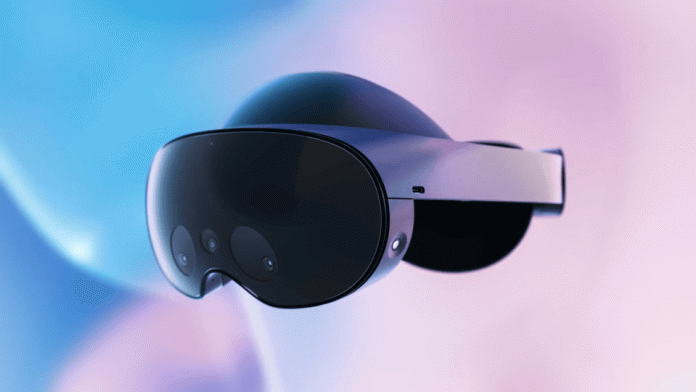
Meta outlined some of the new features in the current Meta Quest software update, including several that take advantage of the expanded capabilities of the Meta Quest Pro headset.

Updates for Meta Quest Pro

Background Audio Playback: Meta now allows users to multitask using Meta Quest Pro, enabling users to listen to music or podcasts while working. The new feature can be tested by launching a streaming service in the Browser and then a game.

Mixed Reality Capture: On Meta Quest Pro, users can now record and share the coolest mixed reality moments, such as some late-night beat matching in Tribe XR or a little living room espionage in I Expect You TO Die: Home Sweet Home.

Public and Shareable Wishlists

Users can make their Wishlist on the Meta Quest Store public to let their friends and family know what virtual reality (VR) titles they’d want to get this year. If users set their Wishlist to Public in the Meta Quest Store tab in the mobile app, they’ll be able to share it with others. 

Updates to the Meta Quest Mobile App

Users’ VR friends will be put front and centre on the Meta Quest Mobile app, making it easier to see when they’re online, what they’re doing, send them a message, or start playing together.

Meta is also adding a widget to the home screen that displays the battery life of users’ headsets and controllers, making it easier to start Casting, accessing and opening apps. And use important device settings.

Avatar Mirror in Meta Horizon Home

It’s now easier than ever to change users’ avatar’s appearance, whether it’s through clothing, a haircut, or an experimental moustache. On Meta Quest 2 and Pro, Meta added a mirror to the Home environment, allowing users to rapidly check their appearance and make adjustments to their avatar in real-time.

Advertisement

Elon Musk: Neuralink ready to undergo clinical trial in humans

Elon Musk announced at the Neuralink Show and Tell event that the Neuralink device is ready to undergo clinical trial in humans in six months, pending FDA approval.

Discussing the main motivation behind Neuralink, Musk said: “It was, actually, my prime motivation which was ‘what do we do about AI?’ What do we do about artificial general intelligence if we have digital superintelligence that… that’s much more smarter than a human. How do we mitigate that risk?”

According to Musk, the overall goal is to create an ‘ultimate whole brain interface’. A generalised input/output device that, as a long-term effect, could interface every aspect of the brain. Its aim is to assist people, especially those with paralysis and such diseases, to regain independence by inserting the device into the brain that will enable them to control computers and mobile devices.

Additionally, Musk said he’s confident the Neuralink device can restore full body functionality for those with spinal injuries.

One of the first two applications for Neuralink aimed for humans is targeting the visual part of the brain, with Musk claiming the device will restore visions for people who lost it or those who were born blind. Meanwhile, the second application targets the motor cortex. Musk said Neuralink initially enabled someone who lost the ability to move their muscle to use their mobile phone faster than someone who has working hands.

Currently, the device is being tested on monkeys and a fake brain simulator, with Musk showing videos of monkeys with Neuralink implants controlling computers with their brains. 

Additionally, Neuralink said the first step along the dimensions for the Neuralink device is the N1 implant. The wireless implant possesses 1,000 channels that are capable of recording and stimulating.

Also seen at the event is Neurolink’s R1 Robot implanting the device in a fake brain. The R1 Robot is built to safely implant the device into the brain without errors. 

Advertisement

PlanetCats combats deforestation through its new crypto venture

Image credit: PlanetCats, Twitter
Media Release by PlanetCats

PlanetCats establishes itself as a blockchain and crypto platform. In the latest development, the company introduces sustainable solutions to save rainforests and earn Passive Income while fighting deforestation. The blockchain platform promotes environmental awareness in the rainforests and wants to build solutions that draw attention to the lungs of planet earth and mass adopt blockchain solutions to give its investors a revenue stream.

The platform uses blockchain technology with a community of supporters and investors that want to save Earth while developing solutions so that preserving becomes more valuable than slash and burning. The newly formed crypto features that are designed to combat deforestation are as follows:

  1. Deflationary Token with a burn mechanism based on the latest deforestation numbers
  2. BUSD Rewards and Staking for Passive Income
  3. Charity activities
  4. Education & Awareness
  5. Bridge & DAO
  6. Collectible & Utility NFTs 
  7. Generate Carbon Certificates to Sell on Voluntary Carbon Market.

In addition, PlanetCoins considers trees one of the essential resources, and they are being destroyed at an alarming rate. Therefore, the platform strives to change this by creating a tokenized ecosystem that will save rainforests through blockchain technology.

They realize that trees are crucial to the planet’s survival and need humanity’s help. That’s why PlanetCats are working on tokenizing trees to prevent deforestation and protect animal habitats and Indigenous people. Also, it strives to reduce pollution and greenhouse gases and to avoid erosion of topsoil and nutrients from leaving soil surfaces.

The founders believe that saving these precious resources can reduce global warming and preserve their environment for future generations. PlanetCats also aims to empower local communities by giving them incentives to grow trees in their area while also allowing them to earn money from selling these trees using their tokens.

The PlanetCats platform enables its users to invest in protecting and conserving wildlife while also receiving passive income from their investments. They’re not just trying to save the planet. They’re trying to make it profitable, as this is the only way to scale the business to create real impact.

Advertisement

Stability AI selects AWS as preferred cloud provider to build AI for the future

Image credit: Stability AI and Amazon

Stability AI has selected Amazon Web Services (AWS) as its preferred cloud provider to build and grow its artificial intelligence (AI) models for image, language, audio, video, and 3D content generation.

Stability AI accelerates its work on open-source generative AI models by utilising Amazon SageMaker (AWS’s end-to-end machine learning solution) and AWS’s established compute infrastructure and storage. Furthermore, Stability AI will work with AWS to make its open-source tools and models available to students, researchers, entrepreneurs, and corporations worldwide.

Stability AI provides generative AI models that generate text, images, audio, video, code, and other data from simple text commands. A high-performance computing cluster with thousands of GPUs or AWS Trainium chips, sophisticated experience, and months of training are required for generative AI or foundational models—models that are adaptable to a range of applications in domains such as language, picture, audio, and video. 

Stable Diffusion Version 2.0 was just launched by the company, and it includes open-source models for cutting-edge picture synthesis, allowing users to create new images from user-supplied text and image inputs. This most recent open-source release additionally includes models for upgrading image resolution and inferring depth information to generate new images.

Compared to self-managed machine learning infrastructure, Amazon said Stability AI would leverage Amazon SageMaker to construct and train machine learning models, saving training time and costs by 58 per cent. The company is deploying one of the largest clusters of machine learning instances on AWS, utilising Amazon Elastic Compute Cloud (Amazon EC2) to run its open-source models, making it easier for developers to access those models. Stability AI intends to employ AWS machine learning and AI services in the future to construct and train future models to obtain the greatest performance at the lowest cost. Stability AI will also make its open-source models available to all AWS customers via Amazon SageMaker JumpStart, the model hub of Amazon SageMaker.

Stability AI founder and CEO Emad Mostaque said Stability AI’s objective is to lay the groundwork for AI to unlock humanity’s potential.

“AWS has played an integral role in scaling our open-source foundation models across modalities. We are delighted to run these models on Amazon SageMaker to enable tens of thousands of developers and millions of users to leverage the power of AI with a robust set of tools. We look forward to seeing the amazing things that developers build and customers design and implement using collective intelligence and augmented technology,” Mostaque stated.

Amazon Vice President of Machine Learning and AI Services Bratin Saha said only AWS has the scalability, dependability, and efficiency in delivering the next generation of AI with Stability AI, allowing billions of people to create magnificent art in seconds.

“Amazon SageMaker will help Stability AI scale its use of machine learning with end-to-end tooling, empowering developers to innovate AI applications and dream up new use cases. We are excited to help them invent new products, services, and experiences for the world with the proven performance of one of the largest-ever clusters of machine learning instances in the cloud,” Saha added.

Advertisement

Accelerating India’s Contribution in Extended Reality Technologies

0
Abhishek Singh, President & CEO of NeGD, Nick Clegg, President, Global Affairs, Meta, Prof Ajay Kumar Sood, Principal Scientific Adviser to the Government of India and Devin Narang, FICCI Committee Member & Country Head-India, Sindicatum Renewable Energy at the launch of the XR Open Source (XROS) fellowship program. Image credit: Meta
Media Release by Meta

Today, we’re announcing that Meta will be supporting the Federation of Indian Chamber of Commerce & Industry (FICCI) with $1 million for the XR Open Source (XROS) fellowship program. Run by FICCI, XROS will support 100 Indian developers working on XR (extended reality) technologies by providing them with fellowships which includes stipend and mentoring. The National e-Governance Division, an initiative of the Ministry of Electronics & Information Technology (MeitY), will be the technical partner to the program.

The program will support developers to make contributions to open-source projects related to the XR technology and will further lay the foundation for India-specific solutions that are affordable, appropriate and localized to Indic languages. The XROS program is part of Meta’s global XR Programs and Research Fund under which the company announced a $2 million fund for the XR Startup program with MeitY Startup Hub earlier this year. XROS further aims to provide developers with the resources they need to create digital public goods and generate potential employment opportunities in the field of XR technologies.

The metaverse won’t be built by one company alone. Through programs like XR Open Source, we will support Indian developers working on these exciting technologies. With their talent, insight and effort, we hope to ensure the next generation of internet technologies are built in an open, collaborative and accessible way.

Nick Clegg, President, Global Affairs, Meta

The vision for India’s techade can only be achieved when the young developers and start-ups, including those from tier II & III cities, contribute to enabling future technologies like XR in the metaverse. I am glad that FICCI and Meta are launching this initiative which will not only focus on providing a monetary boost to the developers but will also support them with the right mentoring to build immersive technologies.

Prof Ajay Kumar Sood, Principal Scientific Adviser to the Government of India

Open source technology-driven ecosystems can play a big role in building robust digital public goods which are interoperable and follow federated architecture. Indian developers, especially from tier 2/3 cities, will play a significant role in shaping the future of emerging technology and the metaverse for India and the world. We are glad to support XROS initiative and hope that program will act as a catalyst to nurture the immersive technology developer ecosystem and the open source community in India. It will be a stepping stone for making this decade India’s TechAde.

Abhishek Singh, President & CEO of NeGD

XROS Fellowship Program is a uniquely curated initiative aimed at supporting Indian developers to make significant contributions to open source projects related to extended reality (XR) technology. The program will provide the necessary impetus towards fueling the growth of investments in future technologies in line with the government’s vision for making India a trillion-dollar economy by 2025. We thank Meta for their support and NeGD for the partnership on this program.

Devin Narang, FICCI Committee Member & Country Head-India, Sindicatum Renewable Energy

The XR Open Source program is our second program in India through which we aim to boost the developer ecosystem around immersive technologies and will further the open ecosystem for building the metaverse. From the very beginning, we have supported and launched various open source initiatives such as No Language Left Behind (NLLB), a single multilingual AI model which supports 200 low resource languages, including 25 Indian languages.

Last year we partnered with the Central Board of Secondary Education (CBSE) to bring immersive technologies to over 10 million students and 1 million educators over the next three years. The partnership with CBSE underscores Meta’s commitment to India, and reflects the joint ambition to universalize STEM education by ensuring that students across India have equitable access to quality educational content which will prepare them for the Future of Work in a digitally powered economy. In June 2022, we launched the LeARn Program to train 40,000 students in AR, and developed the School of AR, a flagship program that up-skilled 1,000 developers to work on advanced capabilities in MetaSpark. Meta’s XR Programs and Research Fund is a two-year $50 million investment in programs and external research with industry partners, civil rights groups, governments, nonprofits and academic institutions.

Advertisement

New chatbot goes online to fight image-based abuse

A screenshot of Umibot's interface. Image credit: RMIT University
Media Release by RMIT University

Image-based abuse – when someone takes, shares or threatens to share nude, semi-nude or sexual images or video without consent – has become a growing issue, experienced by 1 in 3 Australians surveyed in 2019. 

Lead researcher behind the creation of ‘Umibot’, Professor Nicola Henry from RMIT’s Social and Global Studies Centre, said ‘deepfake’ content (fake videos or images generated using AI), incidents where people are pressured into creating sexual content and being sent unsolicited sexual images or videos also count as image-based abuse. 

“It’s a huge violation of trust that’s designed to shame, punish or humiliate. It’s often a way for perpetrators to exert power and control over others,” said Henry, who is an Australian Research Council Future Fellow. 

“A lot of victim-survivors we talked to just want the issue to go away and the content to be taken down or removed but often they don’t know where to go for help.” 

That is what this pilot chatbot is here to address.  

The idea came to Henry after conducting interviews with victim-survivors about their experiences of image-based abuse. 

While the people she spoke to had diverse experiences, Henry said they often did not know where to go for help and some did not know that what had happened to them was a crime.

“The victim-survivors we interviewed said they were often blamed by friends, family members and others and made to feel ashamed, which made them even more reluctant to seek help,” Henry said.

Dr Alice Witt, an RMIT Research Fellow working on the project with Henry, said Umibot is not a replacement for human support, but it is designed to help people navigate complex pathways and provide them with options for reporting and tips on collecting evidence or how to keep safe online. 

“It is not just for victim-survivors,” Witt said. 

“Umibot is designed to also help bystanders and even perpetrators as a potential tool to prevent this abuse from happening.”

How does Umibot work?

Users can type questions for Umibot, or they can select answers from a set of options. 

Umibot also asks users to identify whether they are over or under 18 and if they need help for themselves, help for someone else, or are concerned about something they have done. This will inform what sort of support and information they get to suit their experiences.

Henry says Umibot is the first of its kind that is dedicated to victim-survivors of image-based abuse.  

“There are other chatbots out there that more broadly help people who’ve experienced different online harms, but they are not focused on image-based abuse and they don’t have the same hybrid functionality that allows users to type questions to the chatbot,” Henry said.

A new approach to chatbot design

Created with the support of an Australian Research Council Future Fellowship grant, Henry and Witt worked with Melbourne-based digital agency Tundra to create Umibot using Amazon Lex, an artificial intelligence service for building natural language chatbots.

“We know victim-survivors of image-based abuse face a spectrum of experiences over and above image-based abuse, so we developed Umibot as a fully inclusive and trauma-informed empowerment tool to support people who have diverse experiences and come from different backgrounds,” Henry said.

The team also worked with a diverse range of consultants and did an independent accessibility audit to make sure Umibot was as compliant as possible with global accessibility standards for people with disabilities.

“Our main ethical challenge was to make sure Umibot didn’t cause any harm or trauma, or make the user feel burdened,” Witt said.

“A lot of victim-survivors are not ready to talk to a person about their experiences, so teaching Umibot how to be empathetic and helpful is a way for them to seek support without any pressure.”

Next steps for Umibot

With Umibot available to use right now, the researchers are hoping to develop a Umibot Version 2 for victim-survivors, bystanders and perpetrators of image-based abuse in the next few years. 

“We hope that Umibot will not only empower victim-survivors to find support, but also help us create ‘best practice’ guidelines for designing, developing and deploying digital tools and interventions for addressing online harms more broadly,” Witt said.

Advertisement

Meta advances a new generation of creative expression through mixed reality

Image credit: Meta

Meta will utilise mixed reality to express the next generation of art, culture, and social interaction.

In a statement, Meta is launching Meta House at Miami Art Week from 1 December to 3 December as part of our ongoing commitment to the creative community. It will feature mixed reality experiences, live performances by Doja Cat, first-time GRAMMY nominee GloRilla, and more, as well as installations by up-and-coming artists COVL, YONK, and others.

“I 100% believe the metaverse will become a space for artists because, as artists, we’re constantly having to think about the future and carrying the responsibility of telling the past, present, and future in that sense,” COVL said.

COVL, a young Puerto Rican multidisciplinary artist, worked with Meta on Nuevo Norte (New North), a virtual universe that pays homage to COVL’s background while including her organic, trippy artistic style. COVL will also include Nuevo Norte in an augmented reality (AR) mural that will be displayed in Meta House. COVL collaborated with Meta’s Spark AR team to add a layer of interactivity to the artwork, which can be viewed through Instagram and Facebook cameras. This was COVL’s first time experimenting with AR and VR as art media.

In the fifth episode of its Metaverse Culture Series, Meta gathered together COVL and other new artists and activists, just as Miami Art Week celebrates both conventional and creative forms of art. They address how the Latinx community can both preserve and enhance their rich culture in new ways, as well as achieve progress towards equity on various levels, in a small documentary called Tercera Cultura (third culture). The film includes COVL (D’ana Nunez), Jillian Mercado, Sara Mora, Tori Ortiz, and Juan Veloz.

Meta is also working with the Dutch artist duo “Are We There Yet?” ” guests, YONK, who will give an immersive VR workshop to demonstrate how VR may be used for creative expression to students and visitors.

Advertisement