Getting started on a fitness journey this year doesn’t have to be a struggle — even if you’re a beginner. With the immersive virtual reality (VR) fitness apps on Meta Quest, you can break a sweat whenever and wherever you want.
Whether it’s a boxing session in Liteboxer, firing up some jump shots in GYM CLASS – Basketball VR or swinging away in Racket: Nx, VR fitness is a great way to get your entire body moving.
Android Integration
Once you start your new VR fitness routine, you’ll want to keep track of how you’re doing, whether you’re in VR or not. Everyone can sync their stats to the Meta Quest mobile app, and now, those with Android devices can link and share information directly to Health Connect by Android.
With this new update, you can keep track of all your VR workouts and compile all your stats in the same place that you track your other daily activities on Android.
When you sync with Health Connect by Android, you’ll automatically track your VR workouts on your device without ever having to manually input anything. We announced a similar integration with Apple Health last year.
Heart Rate Integration
One of the most-requested fitness features for Meta Quest has been heart rate tracking, so that you can easily see tangible and real-time results. With our new heart rate feature, you’ll be able to see your heart rate, when measured by a Bluetooth-enabled heart rate monitor, even while you’re in a VR workout.
Now, when you pair a heart rate monitor to your Meta Quest headset, you’ll have access to better and more precise information about how your VR workouts are raising your heart rate. And with that information in hand, you’ll be able to meet your goals.
Heart rate monitors that can work with Meta Quest are the Garmin HRM-Dual and the Polar H10. Other heart rate monitors that use Bluetooth for pairing may also be pairable with your Meta Quest.
Elite Strap Bundle
For a limited time, you can get the Elite Strap for no additional cost when you buy Meta Quest 2. This ergonomic accessory helps you get the most out of your VR workouts by letting you balance and support your headset with a simple twist of a fit wheel, which means you’ll be able to keep your head in the game no matter how active you get.
Tencent Cloud – the cloud business of global technology company Tencent – today announced it has entered into a strategic collaboration with Traac, an authorized reseller of Tencent Cloud for Europe, to provide industry-leading cloud solutions and services and expand the business in the region.
Headquartered in Zug, Switzerland, the heart of Swiss innovations and new technologies hub, Traac has strong competencies in B2B cooperation with leading global vendors, customers and ecosystems, providing best-in-class services in offering cloud solutions and digital products. Currently, Traac is Tencent Cloud’s authorized reseller in 19 European countries, including Austria, Bulgaria, Croatia, Czech Republic, Estonia, France, Finland, Germany, Latvia, Liechtenstein, Lithuania, Luxemburg, Netherlands, Poland, Romania, Slovakia, Sweden, Switzerland and the United Kingdom.
“Setting up a collaboration with Traac, the company which has strong competencies in B2B cooperation and extensive market reach is an important step in building our market position in Europe. We highly value the market achievements, experience, and global markets knowledge of Traac. The Traac team successfully combines strategic thinking with knowledge of new technologies, which can be a valuable asset for our existing and future customers in strengthening their competitive advantage. As demands for digital solutions and cloud technologies continue to see strong growth across Europe, Tencent Cloud will work closely with Traac together to help European customers speed up digital transformation and business growth”, says Leo Li Shiwei, Vice President for Europe, Tencent Cloud International.
“Tencent Cloud is one of the world’s leading cloud companies, providing innovative, stable, and secure industry-leading cloud products and solutions. It is my pleasure and honor to cooperate with such a prestigious company, especially at the time when global digitalization accelerates. Nowadays cloud means not only storage. It is a whole digital products ecosystem. The more digitalized the world, the more cloud and digital products it needs. Together with Tencent Cloud, Traac will provide cutting-edge cloud technologies, helping European companies to accelerate their digital transformation, foster innovations, and build a unique competitive advantage. This is why I am excited about the collaboration with Tencent Cloud and I am proud that I will lead Traac in this mission”, says Ilona Weiss, Chairman of Traac.
Microsoft and Tech Mahindra have announced a strategic agreement to allow cloud-powered 5G core network upgrade for telecom operators worldwide.
The 5G core network transition will assist telecom operators in developing 5G core use cases and meeting the expanding technological (Augmented Reality (AR), Virtual Reality (VR), IoT (Internet of Things), and edge computing) requirements of their consumers. It will also allow them to update, optimise, and protect company operations and construct green networks at lower costs and faster time to market.
As part of the agreement, Tech Mahindra will supply telecom operators with talent experience, complete solutions, and managed services products such as “Network Cloudification as a Service” and AIOps for their 5G Core networks. The modernisation of network core systems and operations enabled by AIOps will allow operators to swiftly and efficiently construct and operate their 5G Core networks while leveraging the power of the cloud to deliver new and creative services to their consumers. AIOps will assist operators in using big data and machine learning to automate network operations activities such as event correlation and anomaly detection, as well as predicting fault and performance concerns, enabling self-serving network operations.
“Today, it is critical to leverage next-gen technologies to build relevant and resilient services and solutions for customers across the globe. At Tech Mahindra, we are well-positioned to help telecom operators realize the full potential of their networks and provide innovative and agile services to their customers while also helping them meet their ESG commitments. Our collaboration with Microsoft will further strengthen our service portfolio by combining our deep expertise across the telecom industry with Microsoft Cloud. Further to this collaboration, Tech Mahindra and Microsoft will work together to help telecom operators simplify and transform their operations in order to build green and secure networks by leveraging the power of cloud technologies,” Tech Mahindra CEO and Managing Director CP Gurnani said.
Microsoft India President Anant Maheshwari added, “Harnessing the power of Microsoft Azure, telecom operators can provide more flexibility and scalability, save infrastructure cost, use AI to automate operations, and differentiate their customer offerings. The collaboration between Tech Mahindra and Microsoft will help our customers build green and secured networks with seamless experiences across the Microsoft cloud and the operator’s network.”
Tech Mahindra will employ the Microsoft cloud for its Sustainability solution iSustain to track and monitor KPIs across all three areas of E, S & G. iSustain will assist network operators in addressing the difficulty of assessing and lowering carbon emissions from networks while satisfying the expectations of numerous energy-intensive digital technologies ranging from AR / VR to IoT. Furthermore, Tech Mahindra will strengthen the operator’s network and operations with SenTindra, a cloud-based virtual security operations centre built on Microsoft Sentinel. SenTindra’s platform provides over 300 scenarios and workflows to serve telecom operators’ cloud visibility, monitoring, and orchestration needs, ensuring network security and uptime.
The collaboration is in keeping with Tech Mahindra’s NXT.NOW framework, which strives to improve the ‘Human Centric Experience.’ Tech Mahindra invests in developing technologies and solutions that enable digital transformation and address customers’ changing needs.
Global technology and software company Emerson has been named the IoT Breakthrough 2023 “Industrial IoT Company of the Year” for the fifth time — an honor the company also received in 2018, 2019, 2020 and 2022. This year’s award recognizes the power of Emerson’s industry-leading Plantweb™ digital ecosystem, which now includes the AspenTech suite of plant optimization software solutions.
Leveraging decades of innovation and expertise, Emerson delivers the broadest suite of automation technology to manufacturers across all industries. Emerson and AspenTech’s leading portfolio of sensor, edge, control and software solutions – the Plantweb digital ecosystem – enables companies to optimize operations and performance of their plants and enterprise.
“Emerson is proud to be consistently recognized as an automation leader with a demonstrated commitment to innovating and providing leading solutions that help customers meet their business and sustainability goals in today’s dynamic markets,” said Ram Krishnan, chief operating officer of Emerson. “By integrating AspenTech into our industry-leading Plantweb digital ecosystem, we provide customers the most comprehensive digital transformation portfolio in the industry, backed by deep automation expertise.”
Plantweb, including the AspenTech portfolio of asset optimization software, enables companies to “See, Decide, Act and Optimize” across their operations. Through its sensing and visualization, predictive diagnostics and monitoring, precision control and AI-powered analytics, Plantweb empowers companies to boost performance, improve safety and achieve sustainability targets through emissions reduction and greater energy efficiency.
“Emerson continues its decades-long streak of digital innovation and leadership across all automation categories, and the company’s breakthrough Plantweb digital ecosystem, optimized with AspenTech, represents a next-generation IIoT platform to help their customers optimize operations and meet business and sustainability goals,“ said James Johnson, managing director at IoT Breakthrough. “Emerson’s robust suite of sensors, software and control technologies are empowering organizations to ‘See, Decide, Act and Optimize’ like never before, and we are thrilled to congratulate the Emerson team for taking home our marquee ‘Industrial IoT Company of the Year’ award in the 7th annual IoT Breakthrough Awards program.”
IoT Breakthrough, which recognizes excellence, creativity and success of Internet of Things (IoT) companies, technologies and products, received more than 4,000 nominations for the 2023 competition. The awards honor the world’s best companies, leaders, technologies and products in a range of IoT categories — from industrial and enterprise, to consumer and connected home. Winners are selected by a panel of senior-level professionals experienced in the IoT space, including journalists, analysts and technology executives.
AI is at the heart of humanity’s most transformative innovations — from developing COVID vaccines at unprecedented speeds and diagnosing cancer to powering autonomous vehicles and understanding climate change.
Virtually every industry will benefit from adopting AI, but the technology has become more resource intensive as neural networks have increased in complexity. To avoid placing unsustainable demands on electricity generation to run this computing infrastructure, the underlying technology must be as efficient as possible.
Accelerated computing powered by NVIDIA GPUs and the NVIDIA AI platform offer the efficiency that enables data centers to sustainably drive the next generation of breakthroughs.
And now, timed with the launch of 4th Gen Intel Xeon Scalable processors, NVIDIA and its partners have kicked off a new generation of accelerated computing systems that are built for energy-efficient AI. When combined with NVIDIA H100 Tensor Core GPUs, these systems can deliver dramatically higher performance, greater scale and higher efficiency than the prior generation, providing more computation and problem-solving per watt.
The new Intel CPUs will be used in NVIDIA DGX H100 systems, as well as in more than 60 servers featuring H100 GPUs from NVIDIA partners around the world.
Supercharging Speed, Efficiency and Savings for Enterprise AI
The coming NVIDIA and Intel-powered systems will help enterprises run workloads an average of 25x more efficiently than traditional CPU-only data center servers. This incredible performance per watt means less power is needed to get jobs done, which helps ensure the power available to data centers is used as efficiently as possible to supercharge the most important work.
Compared to prior-generation accelerated systems, this new generation of NVIDIA-accelerated servers speed training and inference to boost energy efficiency by 3.5x – which translates into real cost savings, with AI data centers delivering over 3x lower total cost of ownership.
New 4th Gen Intel Xeon CPUs Move More Data to Accelerate NVIDIA AI
Among the features of the new 4th Gen Intel Xeon CPU is support for PCIe Gen 5, which can double the data transfer rates from CPU to NVIDIA GPUs and networking. Increased PCIe lanes allow for a greater density of GPUs and high-speed networking within each server.
Faster memory bandwidth also improves the performance of data-intensive workloads such as AI, while networking speeds — up to 400 gigabits per second (Gbps) per connection — support faster data transfers between servers and storage.
NVIDIA DGX H100 systems and servers from NVIDIA partners with H100 PCIe GPUs come with a license for NVIDIA AI Enterprise, an end-to-end, secure, cloud-native suite of AI development and deployment software, providing a complete platform for excellence in efficient enterprise AI.
NVIDIA DGX H100 Systems Supercharge Efficiency for Supersize AI
As the fourth generation of the world’s premier purpose-built AI infrastructure, NVIDIA DGX H100 systems provide a fully optimized platform powered by the operating system of the accelerated data center, NVIDIA Base Command software.
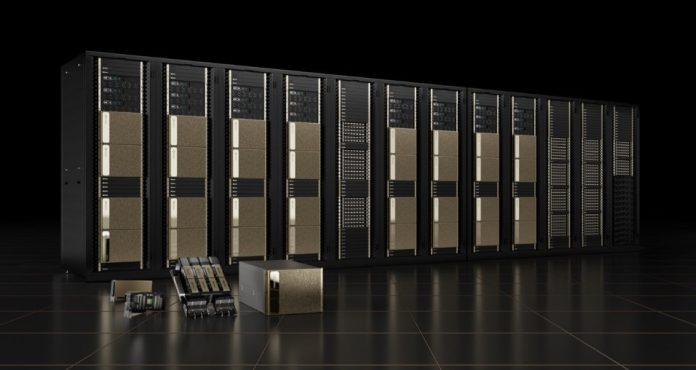
Each DGX H100 system features eight NVIDIA H100 GPUs, 10 NVIDIA ConnectX-7 network adapters and dual 4th Gen Intel Xeon Scalable processors to deliver the performance required to build large generative AI models, large language models, recommender systems and more.
Combined with NVIDIA networking, this architecture supercharges efficient computing at scale by delivering up to 9x more performance than the previous generation and 20x to 40x more performance than unaccelerated X86 dual-socket servers for AI training and HPC workloads. If a language model previously required 40 days to train on a cluster of X86-only servers, the NVIDIA DGX H100 using Intel Xeon CPUs and ConnectX-7 powered networking could complete the same work in as little as 1-2 days.
NVIDIA DGX H100 systems are the building blocks of an enterprise-ready, turnkey NVIDIA DGX SuperPOD, which delivers up to one exaflop of AI performance, providing a leap in efficiency for large-scale enterprise AI deployment.
NVIDIA Partners Boost Data Center Efficiency
For AI data center workloads, NVIDIA H100 GPUs enable enterprises to build and deploy applications more efficiently.
Bringing a new generation of performance and energy efficiency to enterprises worldwide, a broad portfolio of systems with H100 GPUs and 4th Gen Intel Xeon Scalable CPUs are coming soon from NVIDIA partners, including ASUS, Atos, Cisco, Dell Technologies, Fujitsu, GIGABYTE, Hewlett Packard Enterprise, Lenovo, QCT and Supermicro.
As the bellwether of the efficiency gains to come, the Flatiron Institute’s Lenovo ThinkSystem with NVIDIA H100 GPUs tops the latest Green500 list — and NVIDIA technologies power 23 of the top 30 systems on the list. The Flatiron system uses prior-generation Intel CPUs, so even more efficiency is expected from the systems now coming to market.
Additionally, connecting servers with NVIDIA ConnectX-7 networking and Intel 4th Gen Xeon Scalable processors will increase efficiency and reduce infrastructure and power consumption.
NVIDIA ConnectX-7 adapters support PCIe Gen 5 and 400 Gbps per connection using Ethernet or InfiniBand, doubling networking throughput between servers and to storage. The adapters support advanced networking, storage and security offloads. ConnectX-7 reduces the number of cables and switch ports needed, saving 17% or more on electricity needed for the networking of large GPU-accelerated HPC and AI clusters and contributing to the better energy efficiency of these new servers.
NVIDIA AI Enterprise Software Delivers Full-Stack AI Solution
These next-generation systems also deliver a leap forward in operational efficiency as they’re optimized for the NVIDIA AI Enterprise software suite.
Running on NVIDIA H100, NVIDIA AI Enterprise accelerates the data science pipeline and streamlines the development and deployment of predictive AI models to automate essential processes and gain rapid insights from data.
With an extensive library of full-stack software, including AI workflows of reference applications, frameworks, pretrained models and infrastructure optimization, the software provides an ideal foundation for scaling enterprise AI success.
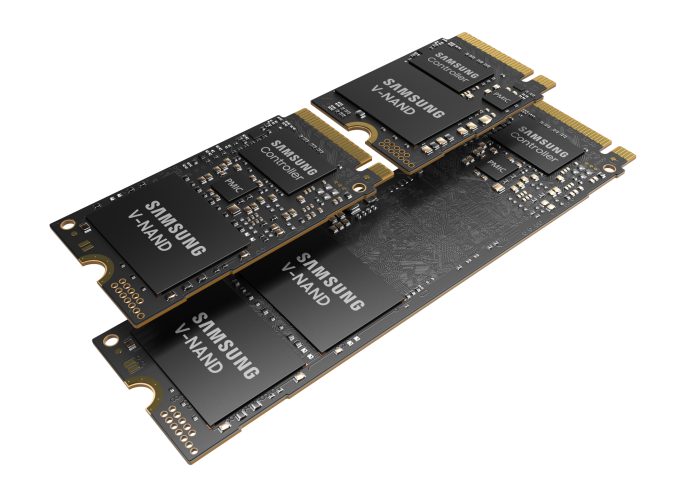
Samsung Electronics announced that the PM9C1a, a high-performance PCIe 4.0 NVMe SSD, is ready for production.
In a statement, Samsung said the PM9C1a, integrated with a new controller based on Samsung’s cutting-edge 5-nanometer (nm) process and the company’s seventh-generation V-NAND technology, will enable enhanced computing and gaming performance in PCs and laptops.
“Our new PM9C1a SSD will deliver a robust combination of superior performance, greater power efficiency and increased security, which are the qualities that matter most to PC users,” said Yong Ho Song, Executive Vice President of Memory Solution Product & Development at Samsung Electronics. “We are committed to creating storage that satisfies the diverse and changing market requirements as we continue to advance innovation in the PC SSD space.”
According to Samsung, the PM9C1a SSD is perfect for everyday use and more demanding computing and gaming activities, thanks to its top-tier speeds. Samsung’s PM9C1a, which uses the PCIe 4.0 interface, has a 1.6x higher sequential read speed and a 1.8x faster sequential write speed than its prior storage product (PM9B1), hitting 6,000 and 5,600 megabytes per second (MB/s), respectively. Furthermore, random read and write rates can handle up to 900,000 and 1,000,000 input/output operations per second (IOPS).
In addition, the PM9C1a has up to 70 per cent higher power efficiency per watt than its predecessor. This means that the new SSD can perform the same number of jobs while using substantially less power. Furthermore, when a laptop PC falls into standby mode, the SSD will use around 10 per cent less power.
The PM9C1a has excellent security to meet the growing demand for greater security measures, according to Samsung. The SSD supports the Trusted Computer Group’s (TCG) Device Identifier Composition Engine (DICE) security standard, developed by a global organisation that produces open standards for computing security. DICE produces cryptographic keys inside the SSD safely, offering device authentication to protect against supply chain assaults – cyberattacks that target firms via vulnerabilities in their supplier network — and an attestation to avoid any firmware manipulation.
Samsung’s PM9C1a SSDs have an M.2 form factor and come in 256GB, 512GB, and 1TB storage capacities.
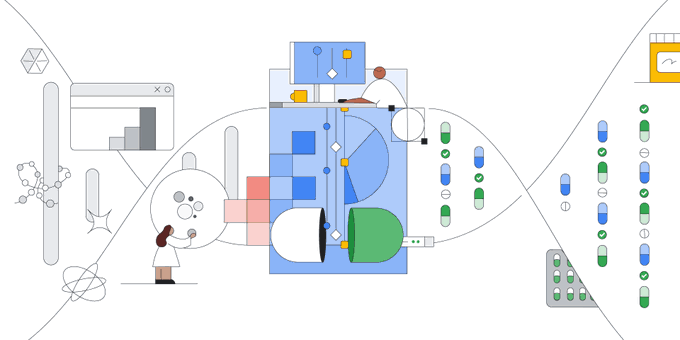
Bayer AG and Google Cloud today announced a collaboration to drive early drug discovery that will apply Google Cloud’s Tensorflow Processing Units (TPUs), which are custom-developed accelerators designed to run cutting-edge machine learning models and computationally-intensive workloads, to help accelerate and scale Bayer’s quantum chemistry calculations.
The theory of quantum mechanics applied to computer-aided drug discovery enables the in-silico modeling of biological and chemical systems with high accuracy, and therefore has the potential to help identify novel drug candidates. The objectives of the collaboration are to accelerate and scale quantum chemistry calculations using Google Cloud’s TPUs and to demonstrate fully quantum mechanical modeling of protein-ligand interactions. The results will determine the scientific and economic viability of large-scale density functional theory calculations for practical applications.
“Bayer’s aspiration to be among the leading innovators drives us to continue to invest in novel and disruptive technologies to solve complex problems,” said Bijoy Sagar, chief information and digital transformation officer at Bayer AG. “Partnering with Google Cloud on TPU powered quantum chemistry complements our ambition to work with industry leaders and experts to quickly deliver on digital transformation.”
“Accelerating drug discovery may be one of the most important applications for AI and high-performance computing in the healthcare industry,” said Thomas Kurian, CEO of Google Cloud. “Bringing Bayer’s powerful research and development capabilities together with our industry-leading infrastructure has the potential to unlock new discoveries—with greater accuracy and speed—helping to get new medicines to patients faster.”
Increasing R&D efficiency to accelerate development of impactful medicines for patients in need is central to Bayer’s innovation strategy.
“By combining Google Cloud’s computing power with Bayer’s leading expertise in drug discovery we intend to unleash the potential of large-scale quantum chemistry,” said Marianne De Backer, Head of Strategy, Business Development & Licensing/Open Innovation and Member of the Executive Committee, Pharmaceuticals Division at Bayer AG. “Working with industry leaders and pioneers to leverage scientific advancements fueled by digital innovations is essential to the present and future of patient care.”
At CES 2023, Samsung unveiled its next steps in driving human-centric innovation that betters the lives of all. The company announced its plans to create seamlessly connected experiences that harness the power of cutting-edge technology and eco-conscious features. Through collaboration with key partners and a vision for the future, Samsung is eager to empower consumers to live a more connected life built on convenience and everyday sustainability.
“At Samsung, our passion has always been to create electronic devices that help people do more,” said Jong-Hee (JH) Han, Vice Chairman, CEO and Head of the DX (Device eXperience) Division at Samsung Electronics. “Our vision is clear, to bring calm to our connected world so that innovation gets back to its original purpose – helping people focus on what matters to them.”
Watch the video below to check out some of Samsung’s CES 2023 highlights from its press conference, booth and key partnerships and products unveiled at this year’s exhibition.
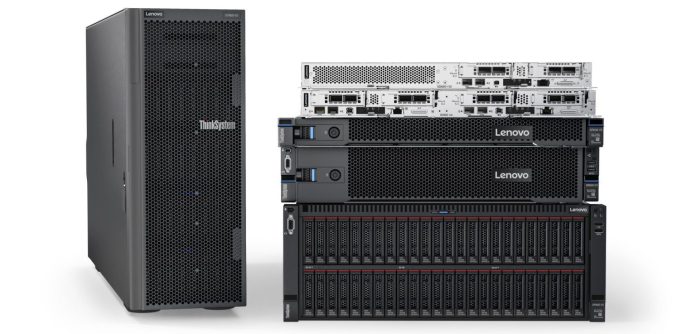
Lenovo showcased 25 new ThinkSystem and ThinkAgile servers and hyper-converged solutions powered by Intel‘s 4th Generation Xeon Scalable Processors.
“In today’s competitive business climate, modern infrastructure solutions that generate faster insights and more efficiently enable complex workloads from the edge to the cloud are critical across every major industry. With the performance and management improvements of the Intel-based ThinkSystem V3 portfolio, customers can reduce their IT footprint by up to three times to achieve greater ROI and more easily transform their infrastructure with one seamless platform designed for today’s AI, virtualization, multi-cloud and sustainable computing demands,” Lenovo Infrastructure Solutions Group Vice President and General Manager of Server & Storage Kamran Amini said.
The newest generation of Lenovo ThinkSystem and ThinkAgile servers and storage with 4th Gen Intel Xeon Scalable processors includes built-in accelerators that help achieve more efficient utilisation and power efficiency across today’s fastest-growing workloads. Lenovo added that the portfolio offers a one-of-a-kind open architecture with sophisticated administration, superior reliability, and expanded security to assist businesses working across multiple clouds while leveraging current IT environments.
Doubling performance for mission-critical workloads
According to Lenovo, solutions powered by 4th Generation Intel Xeon Scalable processors enhance data networking, AI inference, and analytics, giving greater performance to help businesses better manage, process, and analyse the increasing growth of data.
The new high-end ThinkSystem and ThinkAgile V3 servers are designed to more effectively power today’s most demanding workloads across all industries, including in-memory databases, large transactional databases, batch processing, real-time analytics, ERP, CRM, legacy system replacements, and virtualised and containerised workloads, as data demands for today’s businesses grow exponentially. With updated XClarity Controller (XCC2) software, Lenovo said the portfolio also provides faster system configuration setup compared to the previous generation.
Solutions like the ThinkSystem SR850 V3 deliver high performance, dependability, and versatility needed to tackle high-intensity workloads in a dense, 4-socket 2U design, enabling organisations to respond rapidly to expansion needs like increasing data management across manufacturing, healthcare, and financial service applications. The server includes predictive failure analysis, light path diagnostics, and embedded tamper detection to reduce application failures and downtime while providing more secure data centre operation.
Greater performance, less power consumption with new Neptune™ systems
Lenovo’s new ThinkSystem SD650 V3 and SD650-I V3 servers, cooled by fifth-generation Lenovo Neptune™ Direct Water-Cooling technology, extend NeptuneT™ efficiency to a new generation of systems, allowing customers to reduce power consumption by up to 40 per cent while maintaining maximum performance.
“bp is excited to be an early experience site for Intel’s 4th Gen Xeon Scalable processor with Lenovo. With support for faster, next-generation DDR5 memory, PCIe 5.0 and Compute Express Link (CXL) 1.1, our new cluster will enable scientists to shorten their time to discovery. This technology will underpin our research efforts supporting bp’s net zero future,” said Elizabeth L’Heureux, head of HPC, bp.
Lenovo has expanded liquid cooling beyond CPUs and memory over the previous decade to include PCIe, storage, GPUs, and other components. On some models, the new systems use Neptune cooling for High Bandwidth Memory (HBM), providing HPC applications with up to four times higher memory bandwidth and up to 2.8 times generational performance boost. HPC customers can now execute the most demanding modelling and simulation tasks with the latest generation Intel Xeon Max Series CPUs with HBM and Intel Data Center Max Series GPUs, all cooled by Lenovo Neptune™.
Enabling scalable and secure cloud agility for modern IT era
Lenovo said it expedites edge-to-cloud deployment with turnkey solutions to assist customers in accelerating their businesses. The new solutions offer pre-configured, pre-validated, cloud-ready systems with built-in lifecycle management. Businesses may use the new Lenovo Infrastructure Solutions V3 portfolio to expand and manage cloud platforms at scale while providing consistent cloud services.
By 2027, over 90 per cent of global enterprises will be operating containerised applications. While these applications offer rapid prototyping, testing, and cloud deployment, large-scale implementation is challenging. According to Lenovo, orchestrators like open-source Kubernetes enables large-scale deployment automation and are rapidly becoming a requirement in many enterprises to support dynamic cloud-native apps. Lenovo’s open cloud strategy enables best-in-class Kubernetes platforms and application services for container orchestration and delivery of cloud-native applications, allowing for increased hardware utilisation while boosting operational efficiency.
For maximum flexibility, the new Lenovo ThinkAgile V3 HX, MX, and VX hyper-converged infrastructure solutions are pre-integrated with an open ecosystem of partners, including Microsoft, Nutanix, and VMware software capabilities, and are available via TruScale Infrastructure as a Service.
With Lenovo Open Cloud-Automation (LOC-A) integrated software, deployment, provisioning, and monitoring container infrastructure becomes simple, allowing organisations to accelerate rollout by up to 81 per cent faster deployment than normal IT, resulting in a 25 per cent increase in time to revenue. The Lenovo Cloud Native Solution for VMware Tanzu on ThinkAgile VX, for example, enables organisations to run and operate modern infrastructure at scale while managing containers and virtual machines from the same control plane, improving resource utilisation and shortening container development cycles.
Through an additional separation layer of immunity against unauthorised access and harmful assaults, the Lenovo Infrastructure Solutions V3 portfolio improves ThinkShield security and IT resiliency. Lenovo’s Modular Root of Trust protects, detects, and recovers from cyberattacks and digital compromises through enhanced tamper-detection and monitoring embedded in the chip design. At the same time, Lenovo System Guard ensures heightened security during manufacturing, delivery, and deployment through advanced hardware monitoring.
DXC Technology, a leading Fortune 500 global technology services company, has forecast five ways the digital security landscape will impact life and business in 2023 and beyond.
As one of the leading providers of cybersecurity solutions globally with over 3,000 experts helping the world’s largest companies to increase resilience, DXC Technology is seeing an evolving landscape of threats, but also opportunities to tackle them.
1. The cybersecurity arms race will accelerate
Cybercriminals and cybersecurity professionals will both use artificial intelligence (AI) in an increasingly sophisticated battle of wits. In the case of cybersecurity defense, AI has been mainly used to identify patterns of suspicious behavior. Due to the volume of suspect activity and the number of false positives, cybersecurity staff are often overwhelmed.
The good news is that in 2023 and beyond, we should be able to start automating AI-based security controls and response mechanisms – helping to react faster and more accurately to cyberattacks, reducing possible downtime and protecting personal and business critical data.
“While AI can automate threat detection and elimination, the underlying processes are based on an understanding of past activity, which will incentivize cybercriminals to come up with new types of attacks,” said Mark Hughes, President of Security at DXC Technology. “Keeping pace will be a challenge, especially if quantum computing enters the fray in the coming years, which could see today’s defenses breached in seconds.”
2. We’ll need to be cautious about who we think we’re talking to in the metaverse (while keeping a firm hold of our digital wallets)
2023 is set to be important year for the metaverse with Meta, Microsoft, Virbela and others counting on virtual worlds going mainstream. However, activity in the metaverse can raise questions around identity; how do you know that the person you think you are talking to is who they say they are? Digital certificates, perhaps built on the blockchain, could help. These certificates could also be used to secure virtual transactions in the metaverse. What is clear is that as the metaverse expands, so too will the risks.
3. Geo-political cybersecurity attacks will increase but also lead to innovation in defense
Russia’s attack on Ukraine has reminded us in the starkest way possible that warfare is now hybrid and the risks of geopolitically motivated cyberattacks are real. As a result, many cyber insurance policies are now being written to exclude acts of cyberwar, creating challenges for cyber risk mitigation.
With lingering geopolitical tensions, this threat is set to continue in 2023. In fact, with more than 70 countries due to hold government elections in 2023 (events frequently targeted by state-sponsored actors), it will be a challenging year for cybersecurity defenses. However, we can learn from case studies such as Ukraine’s ‘exemplary’ defense against Russian cyberattacks.
4. Cybersecurity attacks will target critical national infrastructure that supplies our homes
When the lights go out or the gas is cut, most people are unlikely to think it’s the result of an industrial cybersecurity breach. But Operational Technology (OT) is an emerging battleground for cyberattacks, with the systems that control and automate factories and civil infrastructure (including power stations and dams) becoming a target.
With ongoing geopolitical tensions, the OT cyber threat will grow in 2023 putting pressure on industries to ensure they stay one step ahead by baking in cybersecurity protection across their operations.
5. Career opportunities in cybersecurity will grow
There is an estimated global shortfall of around 3.4 million cybersecurity workers. With growing threats from advanced technologies, this number is likely to increase.
The cyber skills gap creates career opportunities for people of all ages and backgrounds. In the UK for example, there are currently approximately 1,000 cybersecurity opportunities for graduates listed on the GradCracker careers portal. But it’s not just graduates who can benefit. Many companies offer the chance for people to retrain in cybersecurity.
“The inclusivity of the cybersecurity space extends to neurodiversity,” added Mark Hughes. “For example, DXC’s Dandelion Program helps individuals with autism, ADHD, dyslexia, and other neurological conditions to build careers in IT, including cybersecurity. The growth of the cyber threat creates career opportunities for people of all backgrounds.”
Cyber threats will continue to increase in speed and complexity during 2023 and beyond but so too will the ability to apply the latest technologies, approaches and talent to tackle them. “The cybersecurity arms race is an apt analogy – the right side must win,” concluded Mark Hughes.
Article by Bob Buttermore, Senior Vice President and Chief Supply Chain Officer, Rockwell Automation
For decades, decisions about manufacturing location were heavily influenced by labour...
Article by Steven Fong, Corporate Vice President, APJ Embedded Business AMD
Artificial intelligence is entering a new phase—one that extends beyond digital productivity into the...
Manufacturing teams could use expanded artificial intelligence (AI) capabilities to automate repetitive tasks and connect product data across the lifecycle, according to Autodesk.
The company...
Engineers Australia has called on the Federal Government to place engineering and technical expertise at the centre of Australia’s approach to artificial intelligence (AI),...
Wurth Australia is investing in automated order fulfilment at its Yatala, Queensland and Keysborough, Victoria distribution facilities through a new partnership with supply chain...